Key Points on Packaging with Qualified ODF Machines
Key Points on Packaging with Qualified ODF Machines
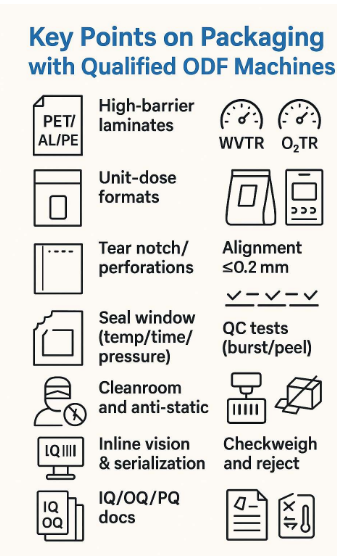
Packaging for oral dissolving films must protect dose integrity and ensure easy, hygienic use. Start with high-barrier laminates (e.g., PET/AL/PE, PA/AL/PE, or cold-form ALU) sized to the film’s moisture sensitivity; target low WVTR/O₂TR and add desiccants only if the laminate and residual moisture specs require it. Choose a unit-dose format—fin-seal sachet, 3-side pouch, or blister—based on tear behavior and child-resistance needs; design tear notches/perforations that open cleanly without fiber shedding. On qualified ODF machines, control web tension, registration, and die-cut alignment (≤0.2 mm) so the active area sits away from seal zones. Validate seal windows (temperature/dwell/pressure) to deliver peelable yet hermetic seals; verify with burst, vacuum-dye, and peel tests plus periodic leak detection. Maintain cleanroom and anti-static controls to prevent particulate pickup and film curling. Integrate inline vision (code/date/lot, print quality, seal defects), check-weight, and reject tracking tied to serialization. Finally, document IQ/OQ/PQ, define critical quality attributes (seal strength, WVTR, microbial limits), and run transport/drop/thermal cycling so the package keeps ODFs intact through real-world distribution.