Precautions When Receiving the Technology for Making Oral Dissolving Films
Author: Sihan Meng,Leyu Zhu,Pengcheng Shi
Affiliation: RSBM
Email: pengchengshi@biotechrs.com; pcspc9@gmail.com
Abstract
Technology transfer (TT) for oral dissolving films (ODFs) is deceptively complex: subtle shifts in polymer grade, solvent class, slot-die geometry, drying ramps, and barrier packaging can derail content uniformity, disintegration, and stability. This paper distills practical precautions for the receiving site across dossier completeness, material equivalence, equipment mapping, utilities/HVAC, computerized systems validation (CSV), training, and packaging. We provide a readiness radar, a likelihood-impact risk matrix, and a 10-week TT Gantt to operationalize controls. The framework emphasizes ALCOA+ data integrity, ASTM-anchored barrier verification, and CPP–CQA translation to reduce deviations and accelerate PPQ readiness [1–7].
Introduction
Receiving ODF technology requires more than copying parameters: film microstructure depends on rheology, coating gap, web tension, and controlled drying/kiln profiles; stability hinges on water activity (a_w), headspace O₂, and laminate selection. TT failures often trace to undocumented tacit knowledge or non-equivalent equipment. We outline precautions to lock product quality, shorten engineering runs, and pass PPQ smoothly [1–4].
Methods
Dossier & knowledge capture. Require bill of materials with supplier/grade, CoAs, rheology windows, and allowable substitutions; capture tacit settings (die-lip shimming, zone ramp recipes, purge times).
Equivalence mapping. Map sender vs receiver for slot-die type, die-lip radius/land, pump pulsation, web path, tension sensor class, dryer zoning/capacity, HVAC class, and sachet sealer jaws/finish.
CPP→CQA translation. Identify coating gap, solids %, viscosity, web speed, dryer ramp, and tension as candidate CPPs linked to CQAs: thickness/content uniformity, disintegration, residual solvent, and a_w.
Packaging verification. Validate WVTR/OTR (ASTM F1249/F1927), seal strength/burst, and headspace O₂; define sealing window (temperature–pressure–dwell) and notch geometry.
CSV & data flow. Verify historian tags, alarm limits, audit trails; qualify PAT (NIR thickness/moisture) and vision systems; ensure ALCOA+ records.
People & training. Role-based SOPs, mock drills, and shadowing; certify critical skills (slot-die alignment, tension calibration, dryer ramp execution, pack integrity tests).
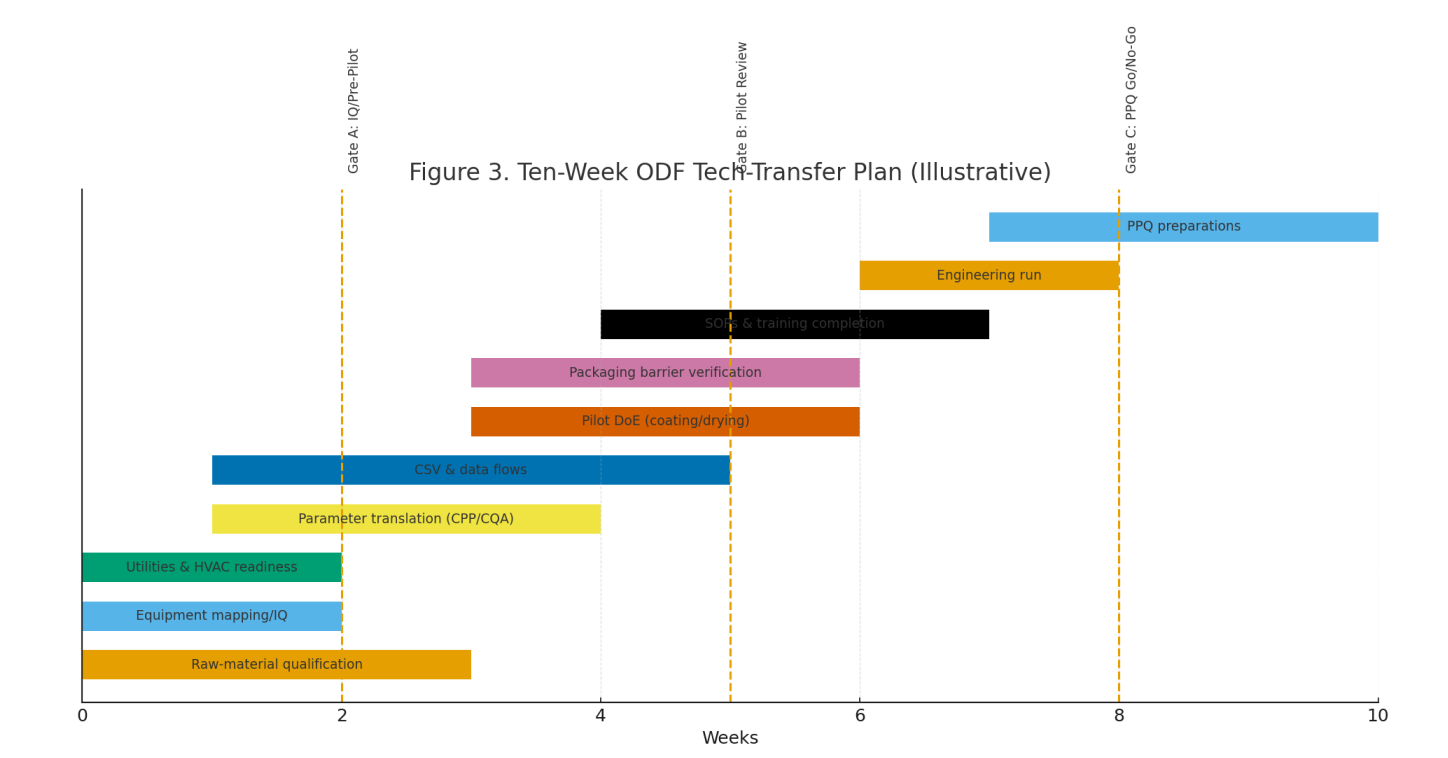
Governance. Gate reviews (IQ/Pre-Pilot, Pilot Review, PPQ Go/No-Go) with change control and CAPA.
Measures
Process: thickness RSD (%), content AV per USP <905>, disintegration (s), residual solvent vs ICH Q3C, a_w, headspace O₂, seal strength (N/15 mm).
Reliability: first-hour scrap, MTBF/MTTR for coating/dryer/packer; alarm rate; % local triage.
Compliance: CSV deviation count, audit-trail completeness, PM/calibration on-time, PPQ first-pass rate.
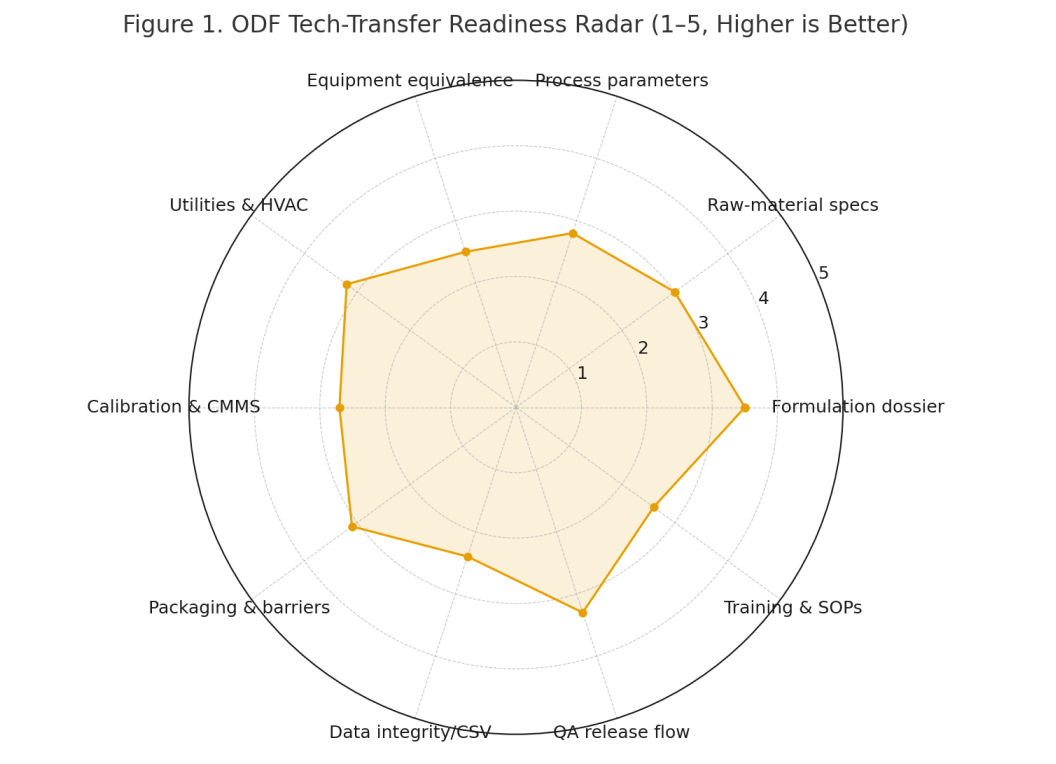
Readiness: radar scores (1–5) for dossier/materials/process/equipment/utilities/CSV/packaging/QA/training (Fig. 1).
Results
Readiness gaps (Fig. 1). Lowest scores appeared in equipment equivalence, CSV/data integrity, training/SOPs, and process parameters—typical drivers of startup deviations.
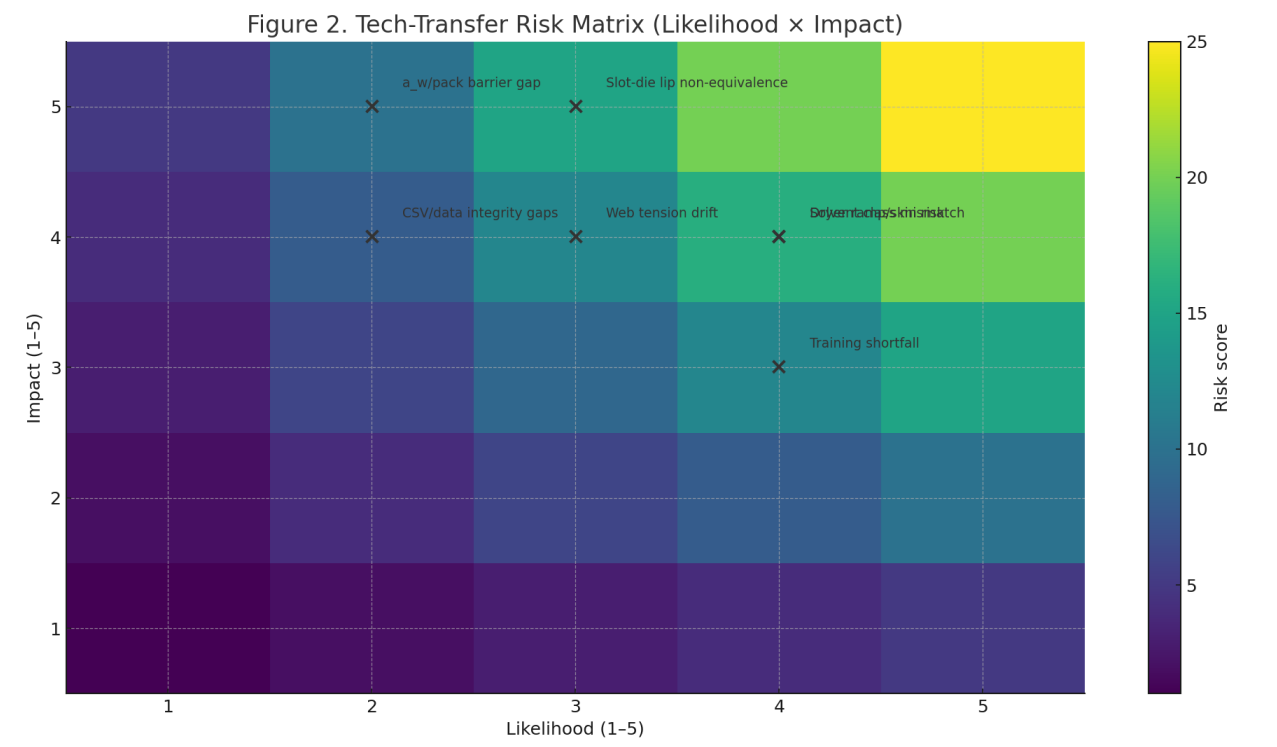
Risk profile (Fig. 2). High-priority risks included solvent class mismatch, slot-die lip non-equivalence, dryer ramp skinning, a_w/pack barrier gaps, and web-tension drift.
Operational plan (Fig. 3). A ten-week plan overlapped raw-material qualification, equipment IQ, CPP translation, CSV setup, pilot DoE (coating/drying), and barrier verification, culminating in engineering runs and PPQ prep—reducing calendar time without compromising gates.
Discussion
Precautions that matter most.
Material sameness: match supplier and grade for polymers/plasticizers; rheology windows ±10% across shear rates; solvent class equivalence for safety and drying kinetics.
Die & web control: certify die-lip geometry and planarity; gauge maps for cross-web thickness; closed-loop tension with calibrated load cells.
Drying ramps: replicate sender ramp profiles (zone temps, ΔT/ΔRH) to avoid early skinning/residual solvent.
Barrier packaging: foil-based laminates for hygroscopic films; verify sealing window and notch placement; monitor headspace O₂.
Data integrity: enforce ALCOA+ with audit trails and historian tag locks; pre-approve bounded local adjustments in SOPs.
Common pitfalls. “Copying” setpoints without CPP rationale; ignoring utilities (HVAC class, dew point); late packaging validation; inadequate operator practice; incomplete CSV leading to unverifiable data.
Conclusion
Successful receipt of ODF technology depends on disciplined equivalence, evidence-based CPP control, barrier-focused packaging validation, and ALCOA+ data integrity—all executed by trained teams under gated governance. The readiness/risk tools and the 10-week plan provide a practical template to minimize deviations and accelerate PPQ.
References
[1] ICH Q8/Q9/Q10: Pharmaceutical development, risk management, and quality system.
[2] EU-GMP Annex 15 & FDA Process Validation: TT, PPQ, and change-control expectations.
[3] USP/Ph. Eur. chapters on orodispersible films, content uniformity, and disintegration.
[4] Thin-film coating/drying controls for slot-die processes; tension and ramp design literature.
[5] ASTM F1249/F1927: WVTR/OTR barrier testing for flexible laminates.
[6] Heat-seal strength and package integrity testing standards (peel/burst, dye penetration).
[7] GAMP 5/CSV and ALCOA+ guidance for data integrity and computerized systems.