End-to-End ODF Manufacturing Full Chain: The Secret to Quality Control from Preforming to Packaging
Author: Sihan Meng,Leyu Zhu,Pengcheng Shi
Affiliation: RSBM
Email: pengchengshi@biotechrs.com; pcspc9@gmail.com
Abstract
Oral dissolving film (ODF) production is a tightly coupled roll-to-roll (R2R) chain in which small drifts at “preforming” (solution prep/rheology setting), coating, drying/conditioning, slitting, and primary packaging propagate into scrap, stability risk, and usability defects. This paper describes a full-chain quality control (QC) architecture that aligns critical process parameters (CPPs) with critical quality attributes (CQAs) and uses SPC, process capability (Cpk), and package performance to maintain a validated performance window (VPW). We propose methods and measurable indicators spanning preforming through packaging and present illustrative results: (i) a p-chart for lot defect rate, (ii) seal-strength boxplots across laminates, and (iii) a thickness capability histogram with Cpk. The framework converts nameplate speed into sustained “good-meters,” higher OEE, and lower lifecycle cost. [1–7]
Keywords
ODF; R2R; CPP→CQA; SPC; Cpk; seal strength; barrier packaging; PAT; QbD; OEE
Introduction
Quality in ODFs is not decided at the coater alone. Preforming determines viscosity, surface tension, and stability of the casting solution; coating and web handling transform rheology into cross-web uniformity; zoned drying/conditioning fixes residuals and curl; slitting converts to unit widths; and primary packaging (sachet/blister) preserves quality and user experience. A full-chain, instrumented control strategy is required to prevent accumulation of variance into thickness bands, pinholes, seal failures, or opening-force complaints. [2–6]
Methods
CPP→CQA mapping.
Preforming: solids, viscosity/shear profile, defoaming, filter rating → coatability, defect risk.
Coating/web: gap, speed, bead stability, tension σ → thickness CV%, P–V bands.
Drying/conditioning: zone ΔT/air, residence time, exhaust/LEL → residual solvent/water, curl.
Slitting: web guidance, blade condition → edge quality, particulates.
Packaging: seal temperature/pressure/time, jaw pattern, dwell → seal strength, OTR/WVTR integrity. [2–5]
Instrumentation & PAT. Inline thickness/moisture/vision, closed-loop tension, zone sensors; gauge GR&R; audit-ready data integrity (ALCOA+). [3–6]
SPC & capability. p-chart/u-chart for defects, X-bar/R and EWMA for CQAs; capability indices (Cp/Cpk) for thickness and seal strength distributions. [4–6]
Verification & stress. FAT/SAT step challenges (±10% speed/σ/T), RH cycling for curl, packaging peel/tear and burst; correlation of upstream metrics with packaging rejects. [5–7]
Measures
Uniformity: thickness CV%, cross-web P–V (µm), Cpk ≥ 1.33.
Residuals & stability: residual solvent/water at exit, water activity (aw), curl index, OTR/WVTR.
Defects & usability: pinholes ppm, streaks/100 m, seal failures per 10k, opening-force window (N/15 mm).
Control health: SPC violations (Western rules), special-cause rates, alarm mean time to react (MTTR).
Operations: good-meters/min, scrap %, changeover min, unplanned downtime hr/month, OEE, 5-year TCO. [4–7]
Results
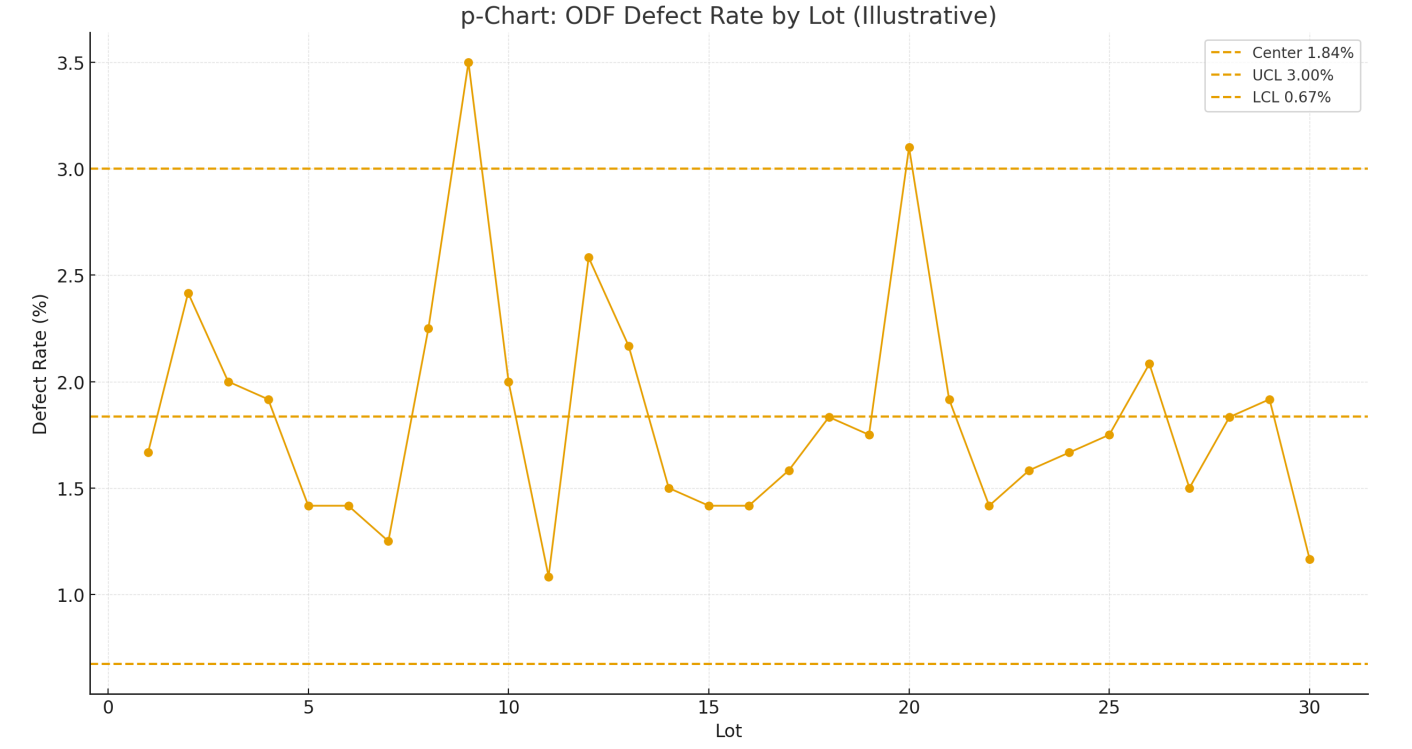
1) p-Chart of Lot Defect Rate
Figure 1 shows a stable center with two special-cause excursions beyond UCL—typical of transient dryer imbalance or tension spikes. Rapid triage links lot-level excursions to time-stamped PAT data to isolate root causes (e.g., bead instability, zone-3 exhaust swing). [4–6]
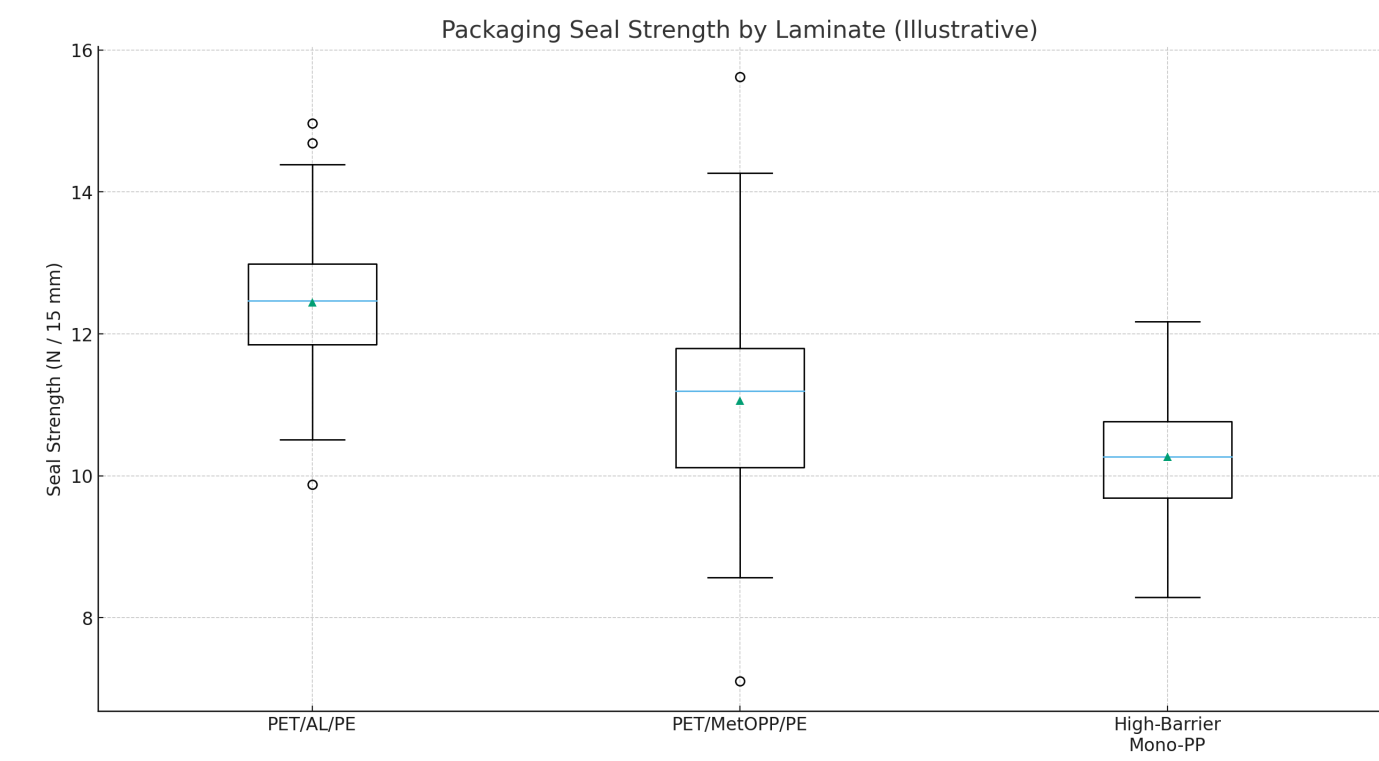
2) Packaging Seal Strength by Laminate
Figure 2 compares PET/AL/PE, PET/MetOPP/PE, and high-barrier mono-PP (illustrative). Wider spread or low-tail outliers predict higher field returns; mono-PP requires tighter temperature/dwell control. Seal-strength SPC is a leading indicator for OTR/WVTR integrity and user opening force. [5–7]
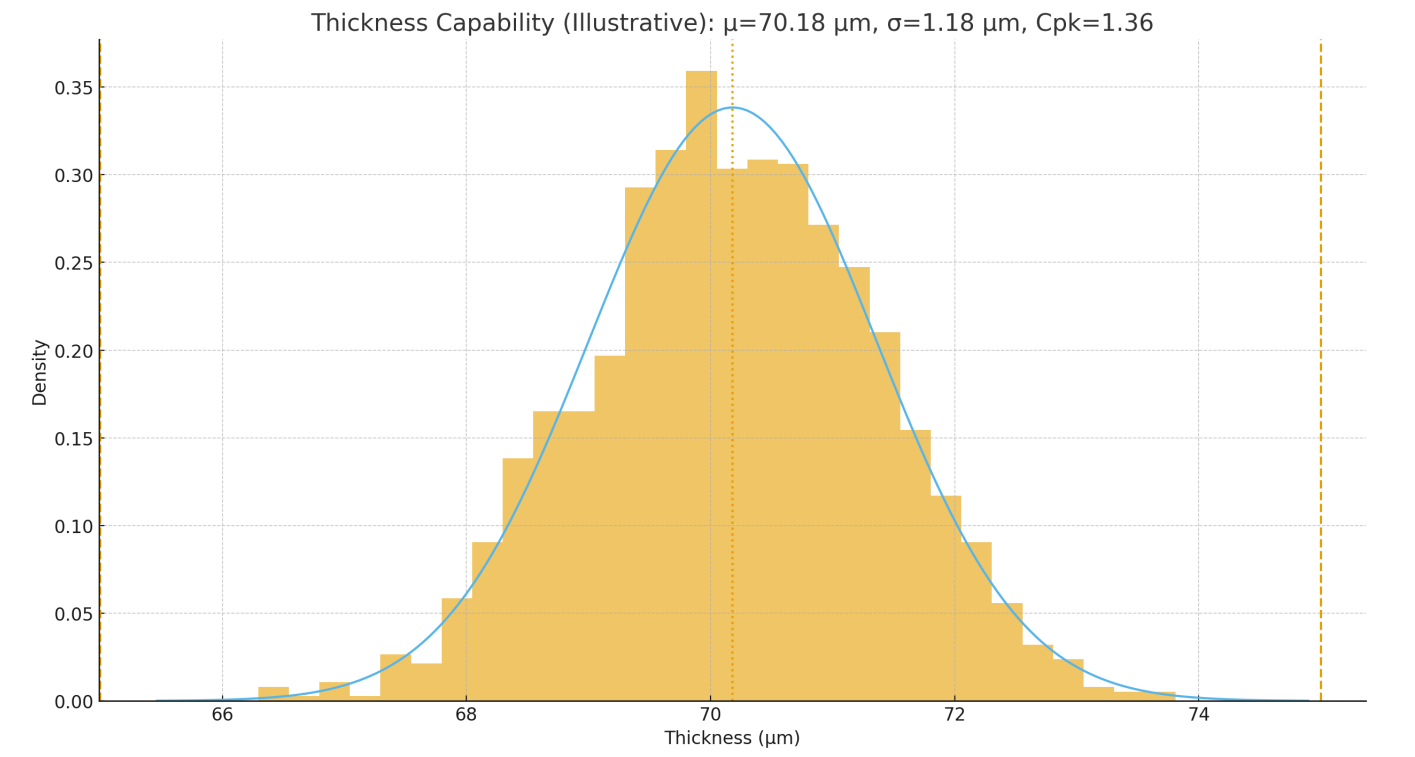
3) Thickness Capability and Cpk
Figure 3 presents a thickness histogram with normal fit and Cpk annotation. A Cpk ≥ 1.33 at target (e.g., 70 µm) indicates robust uniformity and fewer packaging jams/mis-seals downstream (since slit width and sachet fit depend on film gauge). [3–6]
Discussion
Preforming as defect prevention. Proper solids, polymer blend, plasticizer, and antifoam control reduce microvoids and pinholes. Filtration (e.g., 10–20 µm) and hold-time limits avoid viscosity drift and particle growth. [2–3]
Coating/web control as yield governor. Slot-die/comma selection, lip alignment, bead pressure, and tension loop tuning (sensor placement, step-response ≤3 s) prevent bands and edge wander. Edge cameras + thickness gauges provide synchronized alarms. [3–5]
Drying/conditioning as stability gate. Zone power, ΔT uniformity, and residence time govern residuals and curl; exhaust balance protects LEL and prevents local overdrying. Exit residuals must be validated at end-of-shelf-life conditions. [1,5–6]
Packaging as the quality custodian. Seal jaw pattern, pressure, and dwell determine peel force distribution; barrier material selection trades recyclability vs OTR/WVTR. Opening-force windows must align with elderly dexterity while resisting transit abuse. [5–7]
Closed-loop learning. Link SPC violations to PAT and maintenance logs; attack the Pareto of losses (changeovers, web breaks, clean-in-place). Cpk uplift on thickness often pays back via reduced packaging rejects and higher line speed.
Conclusion
End-to-end quality in ODF manufacturing is achieved when preforming, coating/web handling, drying/conditioning, slitting, and packaging operate within a shared VPW, verified by SPC and capability metrics and illuminated by inline PAT. Treat packaging not as a final check, but as a result of upstream precision. Plants that institutionalize this full-chain control convert nameplate speed into sustained good-meters, lower scrap, and superior user experience.
References
R2R drying and residence-time design for thin pharmaceutical films—overview.
Film-forming solution engineering: rheology, defoaming, and filtration for defect prevention.
Coating and web handling fundamentals: slot-die/comma, tension control, and cross-web uniformity.
QbD/PAT for ODFs: gauge GR&R, inline thickness/moisture/vision, and data integrity (ALCOA+).
SPC and capability analysis for thin films and packaging processes.
Multi-zone drying balance, residuals control, and curl mitigation in continuous film lines.
Packaging barrier and seal performance: OTR/WVTR, peel/tear mechanics, and field-return prevention.