The 50-Point ODF Line Audit: Tension, Drying, and Packaging
Author: Sihan Meng,Leyu Zhu,Pengcheng Shi
Affiliation: RSBM
Email: pengchengshi@biotechrs.com; pcspc9@gmail.com
Abstract
This paper presents a 50-point operational audit for oral dissolving film (ODF) manufacturing that spans web handling/tension, multi-zone drying & conditioning, and conversion/packaging. We define a practical CPP→CQA rubric, provide measurable targets (e.g., thickness CV%, residual moisture, seal strength), and illustrate outcomes with three figures: a score heatmap across 50 checks, a tension profile vs spec band, and a seal-strength distribution for pouching validation. The framework helps convert nameplate speed into predictable good-meters and audit-ready releases. [1–8]
Introduction
High-yield ODF manufacturing depends on stable web mechanics, balanced solvent removal, and validated primary packaging. While many plants track isolated KPIs, latent defects propagate cross-station (e.g., over-tension → slit wander → seal leaks). A single, cross-functional 50-point audit aligns process capability (Cp/Cpk) with patient-facing quality (dose uniformity, pouch integrity) and data integrity (ALCOA+). [2–6]
Methods
Scope & structure.
Tension & web handling (10 items): unwind brakes, zone setpoints, ramp/transfer profiles, edge guidance, accumulator logic.
Coating & PAT (10): die temperature, gap & flow, inline thickness/moisture GR&R, defect vision.
Drying & conditioning (10): zone ΔT/airflow, residence, LEL, exit moisture & curl control, conditioning RH/time.
Slitting/die-cut (10): blade sharpness cadence, anvil pressure, slit wander, particulates.
Packaging (10): laminate spec (OTR/WVTR), seal window (T/P/dwell), opening-force window, print/vision. [2–7]
CPP→CQA mapping. For each item, document CPP (setpoint, limit, alarm), linked CQA, and verification method (PAT/SPC vs lab).
Scoring & evidence. 0–1 audit score per check: design in place (0.3), implemented (0.6), capable (Cp/Cpk ≥1.33) with evidence (1.0). [4–6]
Validation logic. PPQ lots with genealogy, Western-Electric rules for SPC, and CAPA triggers on audit gaps. [5–8]
Measures
Geometry & uniformity: thickness CV%, cross-web P–V (µm), residual moisture (%), curl (mm).
Web handling: zone tension (N), tension spikes/transfer overshoot, web breaks per 10k m.
Packaging readiness: seal strength (N/15 mm), opening-force window (N), pouch reject ppm, barcode/print vision ppm.
Control health: GR&R (%), SPC/EWMA violations, alarm MTTR, historian completeness (ALCOA+).
Economics: OEE (%), scrap (%), good-meters/min, changeover (min). [1,6–8]
Results
1) Audit coverage & hotspots
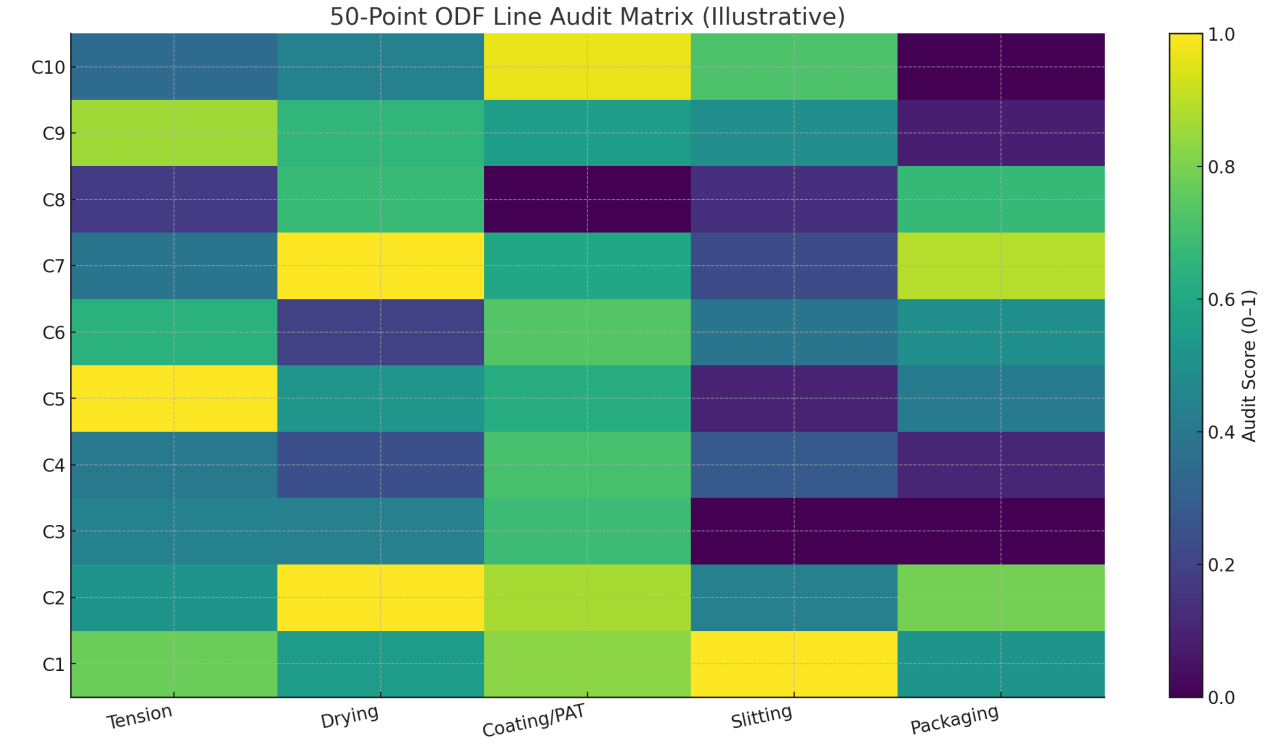
Figure 1 shows a 50-cell heatmap (5 categories × 10 checks) with illustrative scores. Systematic dips often cluster at drying/conditioning (exit moisture bias) and packaging (seal-window depth), guiding targeted CAPA. [3–6]
2) Tension capability
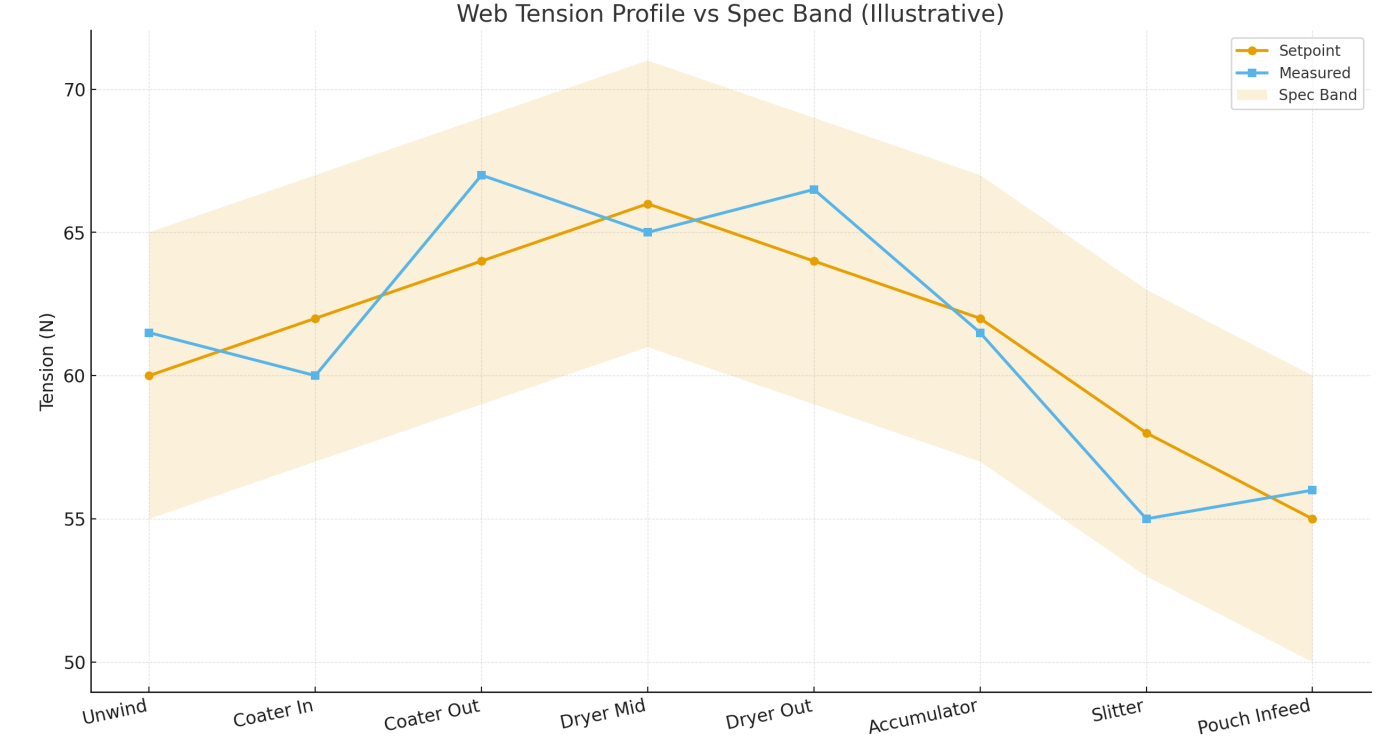
Figure 2 plots setpoint vs measured tension through the line with a ±5 N spec band. Deviations at Dryer Out → Accumulator correlate with curl and slit wander; smoothing ramp logic and tightening feedback gain shrink variance and raise Cp/Cpk. [2–4]
3) Packaging seal strength
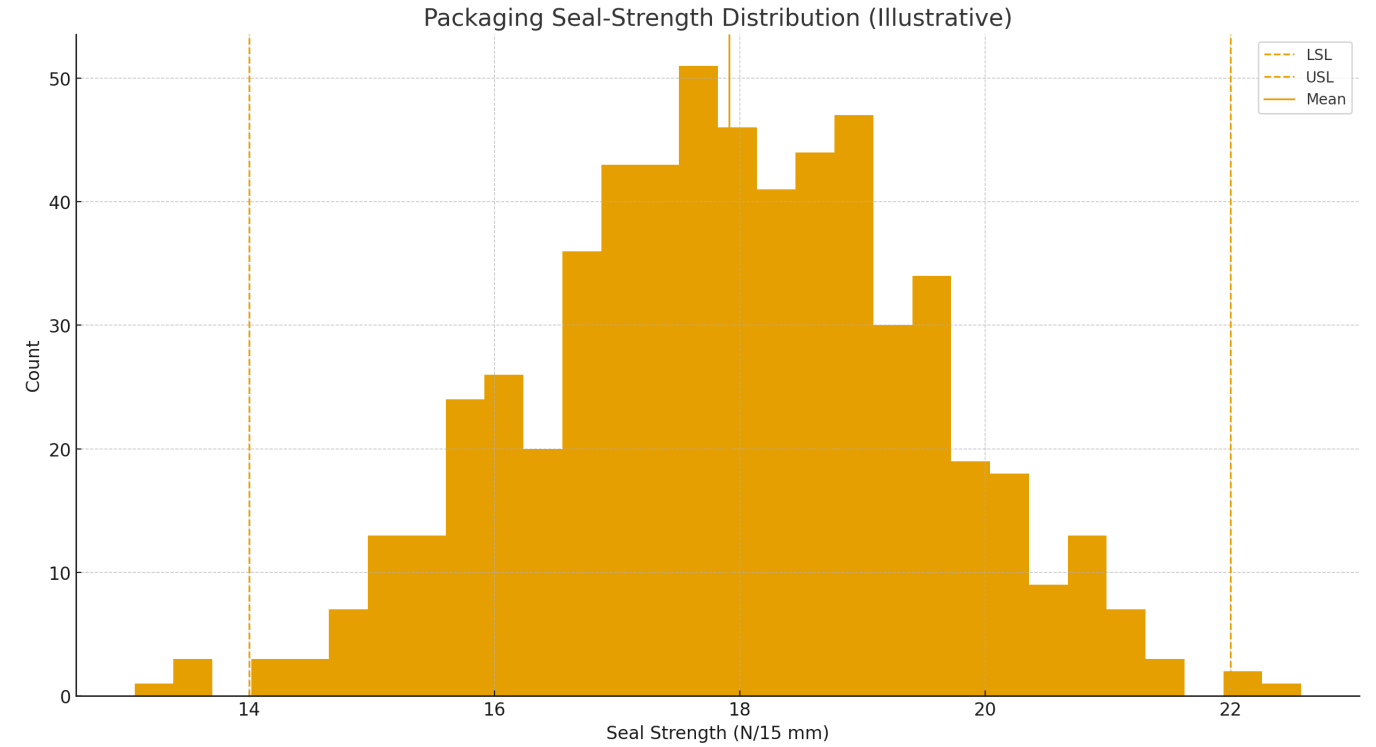
Figure 3 gives a seal-strength histogram with LSL/USL. A centered distribution with narrow spread supports release-by-exception; skew or heavy tails indicate laminate mismatch or jaw-temperature drift, often tied to upstream moisture variation. [5–7]
Discussion
Implementation playbook
Instrument before speed. Qualify inline thickness/moisture/vision; align inline–lab bias and GR&R before rate increases.
Drying balance & conditioning. Use ΔT/airflow zoning to avoid skin-over; set exit moisture spec and conditioning RH/time to minimize curl and blocking.
Tension governance. Specify zone-wise setpoints, transfer ramps, and spike filters; review tension SPC weekly.
Packaging first principles. Map seal window (T/P/dwell) per laminate; verify opening-force and build time-stamped vision links to web position.
Audit cadence. Quarterly 50-point audit with capability dashboards; gaps feed CAPA and PPQ re-runs as needed. [3–8]
Typical pitfalls
Dryers tuned by outlet temperature alone; missing exit-moisture SPC.
Unverified inline gauge GR&R; capability claims without Cpk math.
Running packaging studies before stabilizing gauge/moisture upstream.
No traceability from pouch rejects back to web time/position. [4–7]
Conclusion
A disciplined 50-point ODF audit unifies tension, drying, and packaging under a single capability lens. Plants that embed this rubric, with PAT and SPC/EWMA governance, translate nameplate speed into predictable good-meters, lower scrap, and faster, audit-ready release.
References
OEE and capacity modeling for continuous roll-to-roll lines.
Web handling & tension control for thin films; transfer ramps and feedback tuning.
Multi-zone drying design: ΔT/airflow/residence and moisture/curl outcomes.
QbD/PAT in film coating: inline thickness/moisture/vision, historian, GR&R, ALCOA+.
Packaging integration: seal-window and opening-force validation; laminate OTR/WVTR.
Capability (Cp/Cpk), SPC/EWMA, and Western-Electric rules in validation.
PPQ documentation and deviation/CAPA closure for regulated operations.
Traceability and genealogy linking pouch rejects to web position and time.