Inline PAT for ODF: NIR, Laser Thickness & Vision AI That Actually Works
Author: Sihan Meng,Leyu Zhu,Pengcheng Shi
Affiliation: RSBM
Email: pengchengshi@biotechrs.com; pcspc9@gmail.com
Abstract
Process Analytical Technology (PAT) converts thin-film manufacturing from sample-and-wait to measure-and-control. For oral dissolving films (ODFs), three inline tools—NIR moisture, laser thickness gauging, and vision AI—directly govern release-critical CQAs: residual moisture, thickness CV%/assay RSD%, and surface/edge defects. We present a pragmatic, audit-ready stack: (i) NIR calibrated to lab moisture with routine bias checks; (ii) laser thickness with SPC/EWMA drift detection; (iii) vision AI tuned on defect libraries with confusion-matrix acceptance. Three figures illustrate NIR–lab correlation, SPC on thickness, and a normalized confusion matrix. [1–9]
Introduction
ODFs demand tight moisture to avoid curl/blocking, uniform thickness to protect dose, and clean surfaces/edges to prevent pouch rejects. Offline testing is too slow: the film has already become scrap. Inline PAT closes the loop in real time, feeding SPC/EWMA and alarms to a historian (ALCOA+). This paper details how to stand up NIR, laser thickness, and vision AI that meaningfully reduce defects and variability on production lines. [2–6]
Methods
NIR moisture (inline).
Calibration set (≥8–12 lots across seasons).
Reference: Karl Fischer/loss-on-drying; fit PLS with orthogonal blanking; lock model v1.0; set recalibration triggers.
Daily bias check with 3-point mini-set; auto-alarm if |bias| > threshold. [3–5]
Laser thickness.
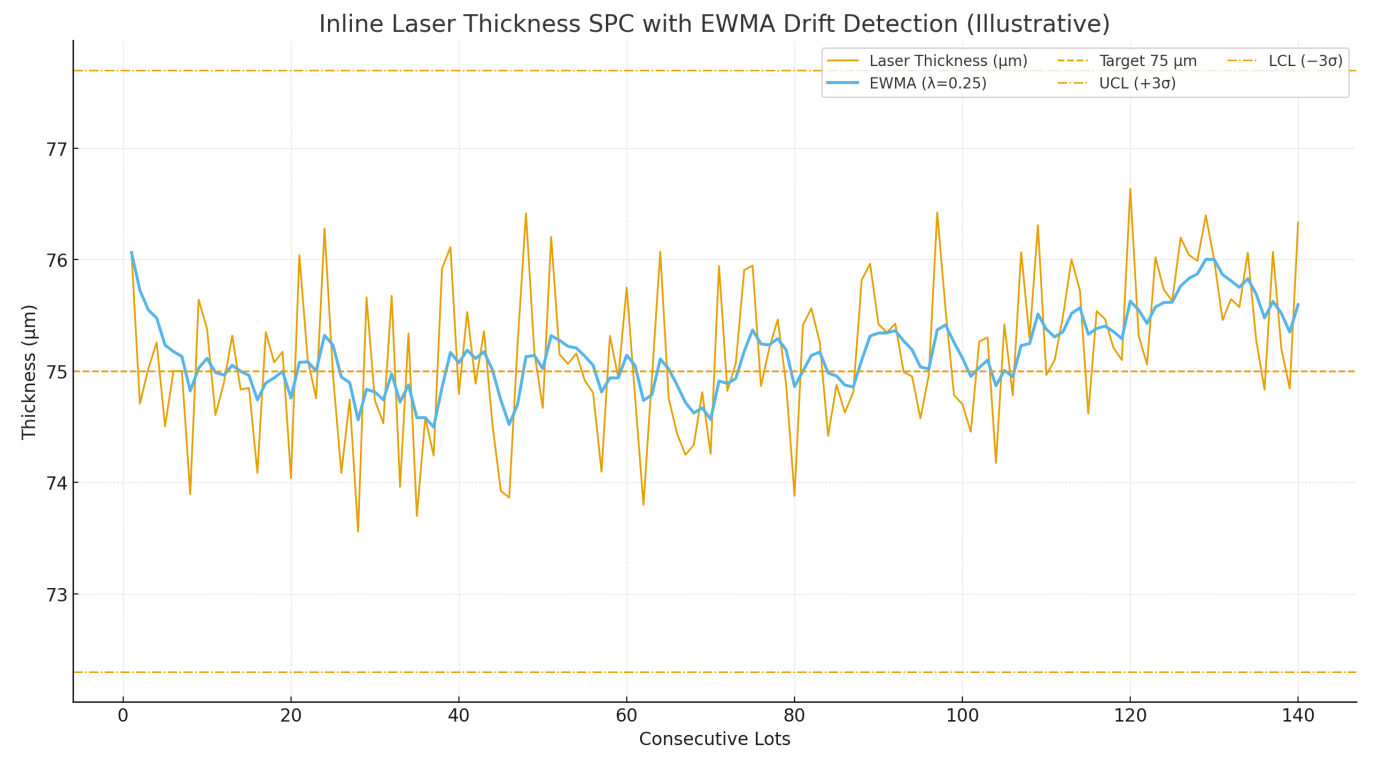
Cross-web mapping (center + edges) at fixed intervals; EWMA (λ≈0.2–0.3) layered on individuals chart; Western-Electric rules for drift.
EBR/lip-shim plan tied to cross-web P–V. [2–5]
Vision AI.
Defect taxonomy: pinholes, edge cracks, mottle/blush, foreign specks, OK.
Train/val/test with hard negatives; compute confusion matrix; gate model on recall for safety-critical defects (pinholes/edge cracks). [6–8]
Data integrity & control.
PAT → historian: time-stamped, versioned, access-controlled (ALCOA+); bidirectional tags to line PLC for rate/heat/air tweaks. [4,8–9]
Measures
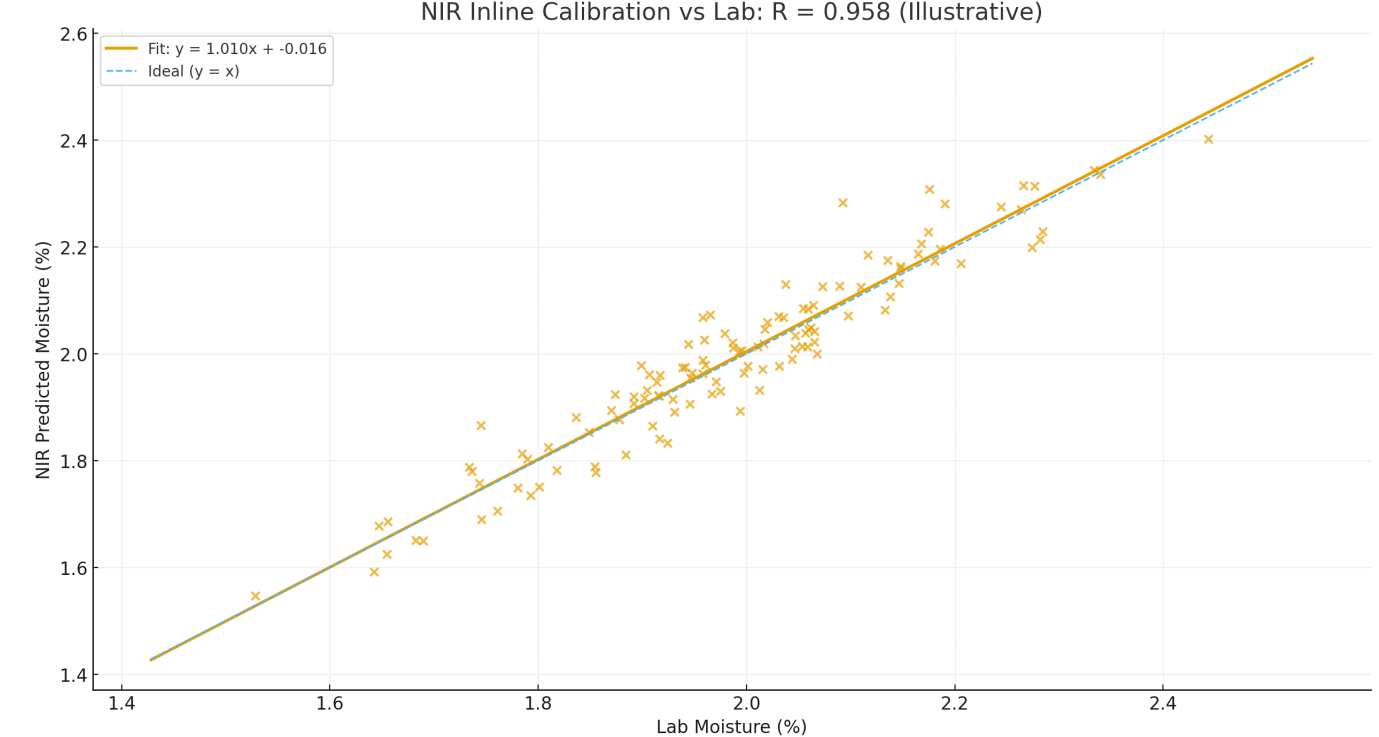
Moisture: NIR–lab R, slope, bias (%, absolute); % lots within 1.6–2.4% at slitting.
Thickness: mean (µm), CV%, cross-web P–V (µm), EWMA drift time, SPC violations.
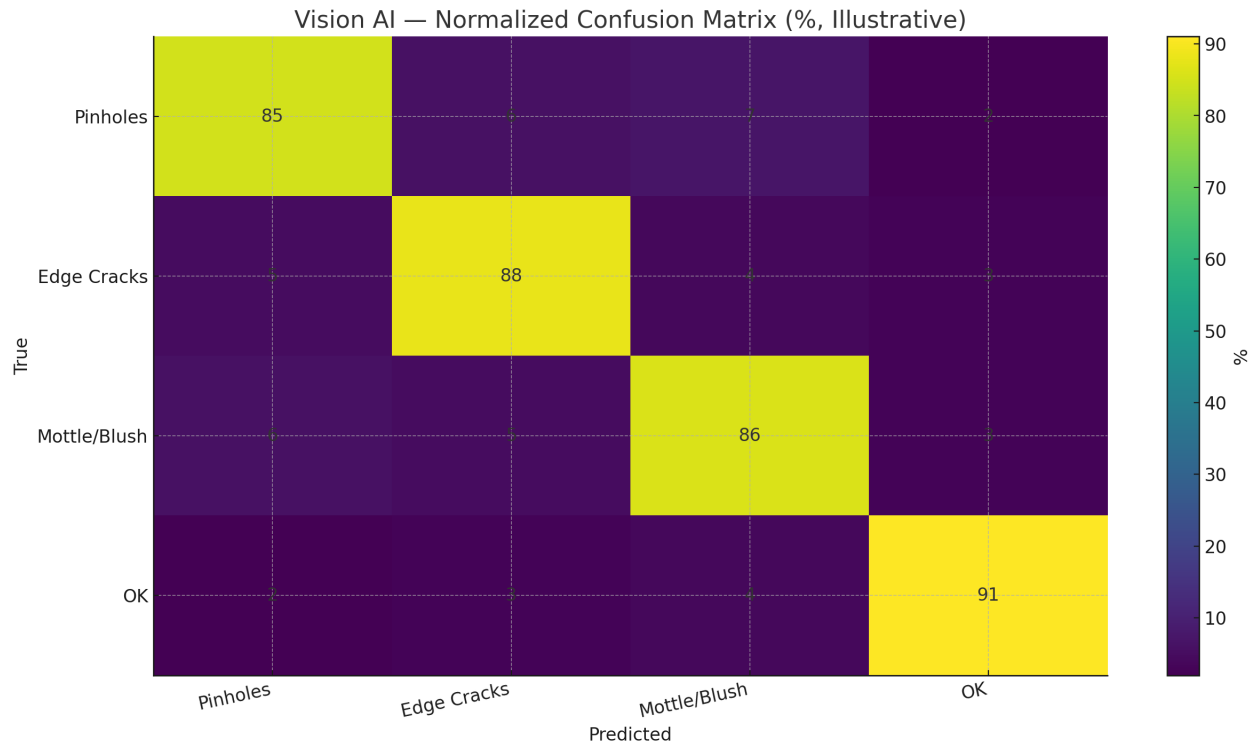
Vision: per-class precision/recall/F1, normalized confusion matrix, false-reject ppm.
Business: scrap %, rework hours, pouch reject ppm, OEE. [3–9]
Results
NIR that tracks the truth
Figure 1 shows a strong NIR–lab correlation with a small positive bias; the fit vs ideal line flags calibration slope/intercept. Routine 3-point checks bound bias drift and keep exit-moisture inside window. [3–5]
Thickness under statistical control
Figure 2 demonstrates SPC + EWMA on laser thickness. An emerging post-lot-100 up-drift is detected by EWMA before individual points breach ±3σ, enabling a controlled nudge (ΔT/impingement, solids% or lip-shim/EBR) before scrap accumulates. [2–5]
Vision AI that catches real defects
Figure 3 presents a normalized confusion matrix across Pinholes / Edge Cracks / Mottle–Blush / OK. High on-diagonal values and low off-diagonal leakage indicate deployable performance; thresholds are set to favor recall for safety-critical classes, with a tuned post-classifier to reduce false rejects. [6–8]
Discussion
What actually works on a line
Calibrate across humidity seasons. Moisture optics shift; lock a model and a re-calibration policy (trigger: sustained bias or RMSEP rise).
Pair individuals with EWMA. For thickness, EWMA catches small drifts from die warming or dryer load long before they blow limits.
Defect taxonomy first, AI second. Clear labeling rules beat fancier models. Keep a golden set for regression testing after upgrades.
Close the loop. Wire PAT tags to PLC recipes with signed change control; alarm routing and hold-limits should be rehearsed (mock alarms).
Cross-web is where money hides. EBR and lip-shim tuning flatten P–V, cutting edge trim and assay RSD.
Compliance & data integrity (ALCOA+)
Attributable users, immutable raw signals, versioned models, contemporaneous event logs; periodic review reports with SPC summaries and model health metrics. [4,8–9]
Conclusion
Inline NIR, laser thickness, and vision AI—implemented with calibration discipline, SPC/EWMA, and robust data integrity—turn ODF production into a controllable, predictable process. The payoff is fewer defects, tighter CQAs, faster release, and credible, audit-ready digital records.
References
PAT frameworks and real-time release concepts for continuous/batch processes.
Slot-die/web handling links to thickness uniformity: die distribution, EBR, lip shims.
NIR moisture modeling: PLS calibration, bias/range management, validation sets.
QbD/PAT governance: historian (ALCOA+), SPC/EWMA, Western-Electric rules.
Drying/conditioning and residual moisture windows for flat, pouch-ready films.
Industrial vision for web defects: labeling taxonomies, thresholds, and deployment.
Confusion-matrix analysis and cost-of-error tuning for safety-critical defects.
Model lifecycle management: golden datasets, drift monitoring, change control.
Audit-ready data integrity: access control, time-stamps, backups, and e-records.