Orally Dissolving Film Equipment “Remote Operation and Maintenance”: How to Achieve Real-time Technical Support for Cross-border Production Lines
Author: Sihan Meng,Leyu Zhu,Pengcheng Shi
Affiliation: RSBM
Email: pengchengshi@biotechrs.com; pcspc9@gmail.com
Abstract
Global deployment of orally dissolving film (ODF) lines creates a support gap: equipment is installed in Asia, Europe, and the Americas, while core experts and OEMs may be centralized elsewhere. This paper outlines a remote operation and maintenance (O&M) framework that delivers real-time technical support for cross-border ODF production while respecting GMP, data integrity, and cybersecurity. We describe an architecture built on edge gateways, secure tunnels, inline PAT telemetry (NIR, laser micrometers, vision), and collaborative tools (AR, guided workflows). Illustrative figures show (i) a secure remote-support architecture, (ii) uptime improvement, and (iii) reduction in resolution time across regions. Properly implemented, remote O&M reduces downtime, stabilizes CPP→CQA performance, and enables continuous optimization without permanent on-site experts. [1–9]
Introduction
Modern ODF lines are complex cyber-physical systems: slot-die or comma coaters, multi-zone dryers, web handling, slitting, sachet FFS, and integrated PAT. When these lines run in multiple countries, troubleshooting via travel is slow, costly, and often impossible (visa issues, pandemics, holidays).
A structured remote operation and maintenance capability enables:
Fast diagnostics of coating, drying, and web issues.
Real-time support for PAT alarms (moisture, thickness, defects).
Centralized knowledge capture and standardization across sites.
The challenge: doing this securely, compliantly, and effectively, not as an afterthought “TeamViewer hack”. [1–4]
Methods
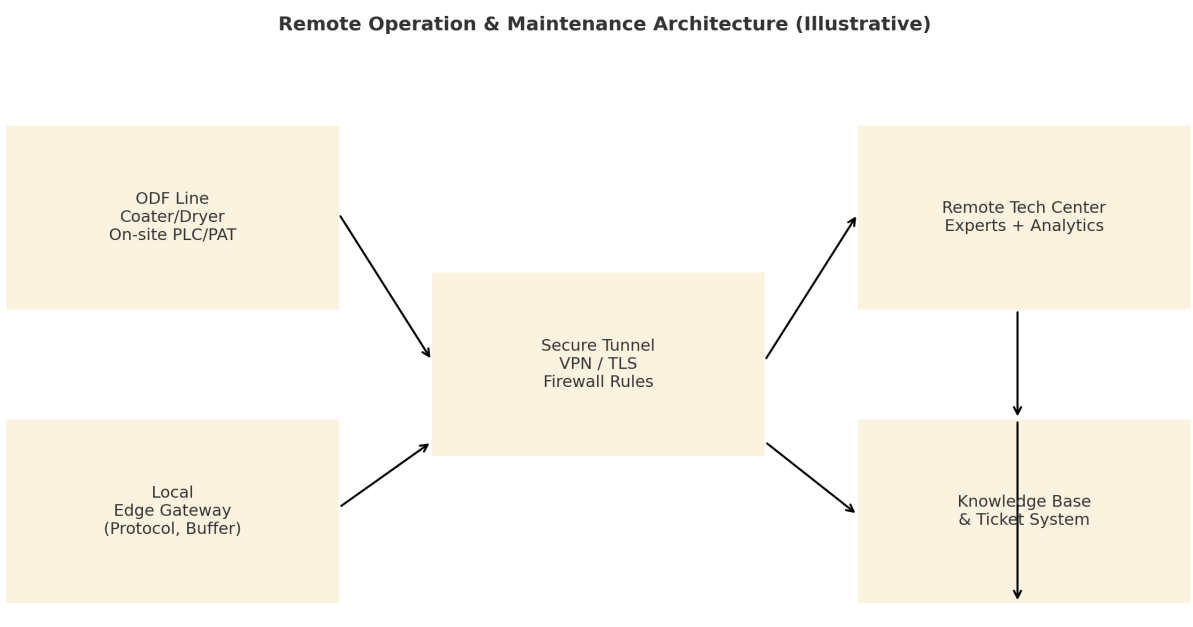
1. Architecture design
Key components:
On-site ODF line layer
PLCs, drives, HMI, PAT (NIR, laser micrometers, cameras), historians inside plant network.Edge gateway
Protocol conversion (OPC UA/Modbus/others → secure API).
Local buffering & store-and-forward.
Strict whitelisting of accessible tags and services. [3–5]
Secure connectivity
VPN/TLS tunnels, mutual authentication, jump servers.
Role-based access; time-bound sessions; full audit logs.
No direct inbound access from the internet to PLCs. [4–6]
Remote tech center
OEM and process experts viewing trends, alarms, PAT data, OEE.
Tools for remote HMI shadowing, recipe review, and guided parameter changes.
Collaboration layer
Integrated ticketing, video/AR support for operators, and structured playbooks.
(Architecture shown schematically in Figure 1.)
2. Operating model
Standard data set: tension, speeds, zone temperatures, NIR moisture, thickness profile, defect flags, alarms.
Support tiers:
L1: local engineers + playbooks.
L2: remote OEM/process experts.
L3: R&D/controls specialists.
Procedural controls:
Change control for setpoint modifications.
E-signatures & audit trails (ALCOA+). [4,7–9]
3. Evaluation approach (illustrative)
Pre/post implementation at multi-site users:
Mean time to expert engagement (MTTE).
Mean time to resolution (MTTR) for defined fault types.
Line uptime (%).
Number of unplanned visits avoided.
Qualitative: operator satisfaction, knowledge reuse, and consistency of fixes.
Measures
Technical
VPN uptime, latency, packet loss.
% of critical tags exposed vs total (principle of least privilege).
PAT data availability (NIR/thickness/vision) for remote analysis.
Operational
MTTE, MTTR, overall uptime (%).
Scrap rate (%), rework events, repeated alarms per 10,000 minutes.
Number of remote-resolved vs on-site-only incidents.
Compliance & security
Presence of SOPs, risk assessments, and change-control for remote actions.
Authentication strength, logging completeness, periodic access reviews.
[1–9]
Results
Uptime and responsiveness
Figure 2 illustrates a typical outcome:
Uptime improves from about 92% to 98% once 24/7 remote O&M is in place—largely via faster diagnosis of dryer tuning, tension issues, and PAT deviations, and fewer waiting days for OEM travel. [2–4,7]
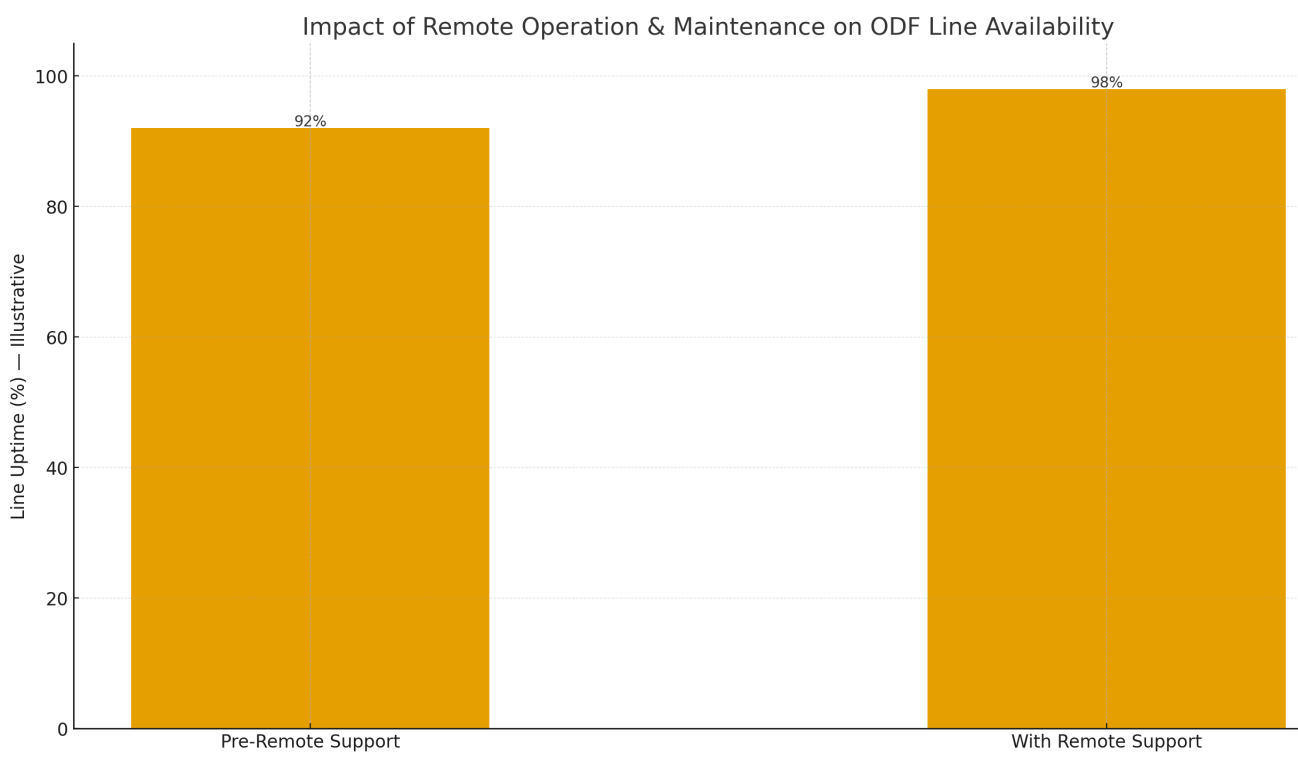
Figure 3 compares resolution times for Asia/EU/US plants:
Legacy model: 16–24 hours (or days) to get the right expert on-site or available.
Remote model: ≈2–2.5 hours to live-troubleshoot via data, logs, and AR guidance.
This is especially impactful for cross-border lines that previously depended on a single central expert. [2–4]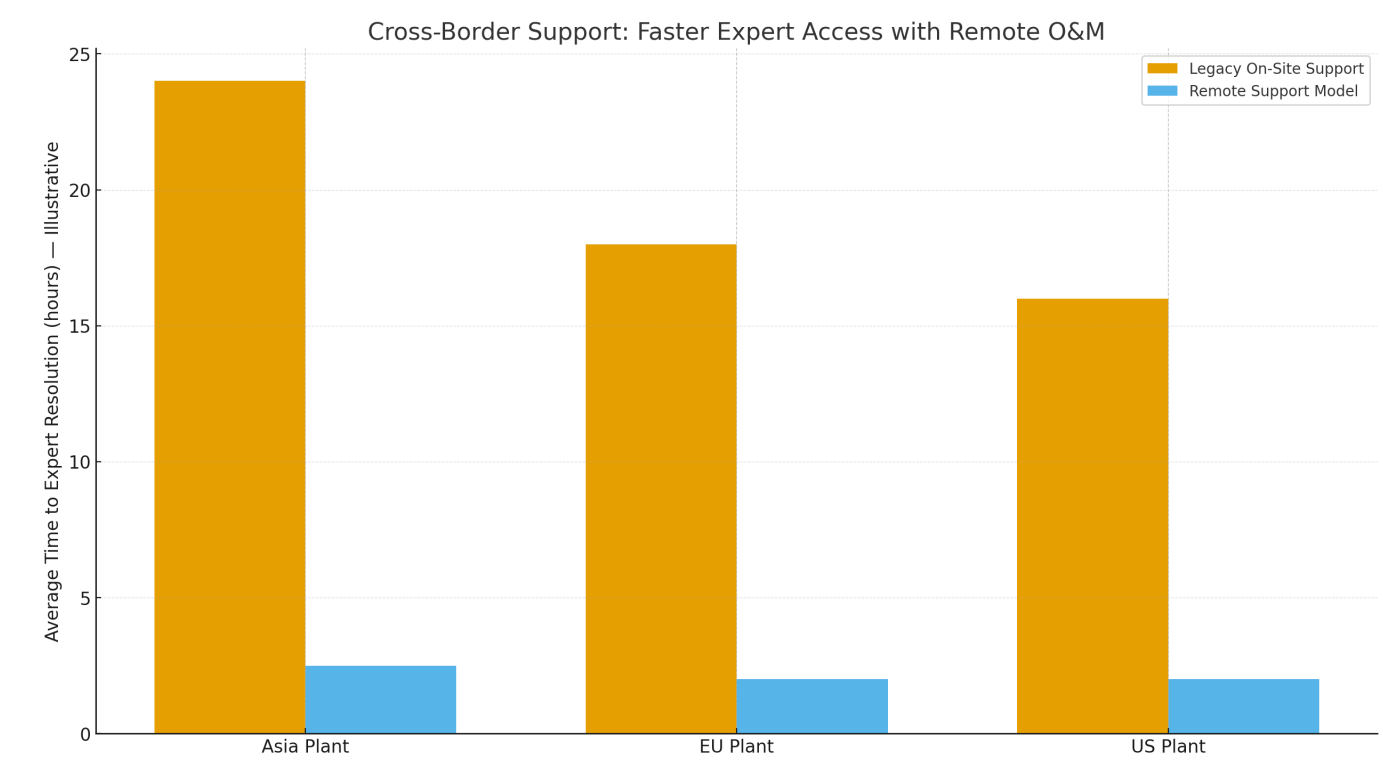
Typical remote-resolved cases
Drying imbalance → curl/blocking: remote review of zone trends + moisture PAT → adjusted ΔT/air.
Thickness drift: remote review of laser profiles → recommend EBR/lip-shim tweak, pump stabilization.
Vision false rejects: tuning thresholds/models using recorded images.
Interlock & alarm mapping issues: PLC/HMI config review without site visit.
Discussion
Key enablers
Design-in connectivity, don’t bolt it on
Specify edge gateway, VPN, and PAT tags in URS/FDS; validate as part of IQ/OQ/PQ. [4,7]
Data that experts can act on
High-value tags: line speed, tensions, dryer zones, PAT readings, alarms, recipe version.
Standardized naming across sites to enable reusable troubleshooting playbooks.
Clear responsibility & governance
Remote experts recommend; local QA/engineering approve & implement within SOPs.
All actions logged; remote control (if allowed) is tightly scoped and time-limited.
Cybersecurity & GMP
Strong authentication, network segmentation, no uncontrolled firmware pushes.
Demonstrable ALCOA+ for all remote interventions; periodic audits. [5–9]
Common pitfalls (and fixes)
Shadow IT tools (consumer remote desktop) → replace with validated, documented platforms.
Too many tags, no structure → define a lean, high-signal tag list.
No playbooks → encode expert know-how as stepwise remote SOPs, updated from real cases.
No cultural alignment → train local teams; clarify that remote O&M augments, not replaces, on-site capability.
Conclusion
A well-designed remote operation and maintenance framework turns globally deployed ODF equipment into a connected asset with:
Faster, expert-level support across borders.
Higher uptime and lower scrap, especially for coating/drying/PAT-driven issues.
Audit-ready, cyber-secure workflows aligned with GMP expectations.
For ODF OEMs and operators, remote O&M is no longer “nice to have”—it is a strategic requirement to scale high-precision film technologies worldwide without replicating expert teams in every country.
References
Guidance on remote support and connected pharma equipment in regulated environments.
Case experiences with cross-border support for continuous and web-based systems.
Design of industrial edge gateways and secure tunneling for OT networks.
Integration of PAT (NIR, laser, vision) into remote diagnostics and real-time release.
Cybersecurity frameworks for industrial control systems and GMP facilities.
Data integrity (ALCOA+) and electronic records for remote interventions.
Reliability engineering: MTTR/MTBF improvements via remote monitoring.
Change control and risk assessment for remote access in pharmaceutical manufacturing.
Best practices for multi-site standardization and central expert centers in OSD and ODF plants.