Web Handling Mastery: Tension Control, Dancer vs Load Cell, Path Design
Author: Sihan Meng,Leyu Zhu,Pengcheng Shi
Affiliation: RSBM
Email: pengchengshi@biotechrs.com; pcspc9@gmail.com
Abstract
Consistent web handling is fundamental to high-yield production of oral films, buccal films, flexible packaging and other thin substrates. Instability in tension or path design leads directly to coating non-uniformity, registration errors, wrinkling, breaks, and elevated waste. This paper presents a practical framework for “web handling mastery” built on three pillars: (1) robust tension control, (2) informed selection and tuning of dancer vs load-cell feedback systems, and (3) engineered web paths optimized for stability, responsiveness, and process integration. Using representative thin-film processes, we compare control strategies, quantify their impact on key performance indicators, and provide design rules that can be directly applied to new lines or retrofits. [1–5]
Introduction
In continuous processes for ODFs and related products, the web is both carrier and product. Its mechanical behavior is influenced by:
Substrate modulus, thickness, width, and viscoelasticity,
Tension setpoints and disturbances,
Idler geometry, wrap angles, and path topology,
Drives, brakes, and splices,
Thermal and humidity conditions around dryers and coaters. [1,2]
Poorly controlled webs produce:
Coating weight variation,
Mis-registration at die-cutting and printing,
Creases, bagging, telescoping,
Frequent breaks, slow restarts, and high scrap.
This paper addresses three interdependent design questions:
How to establish and maintain appropriate web tension.
How to choose between dancer and load-cell feedback (or hybrids).
How to design the web path to be inherently stable and forgiving.
The aim is a practical guide suitable for pharmaceutical, packaging, and specialty film lines.
Methods
1. Tension Control Fundamentals
Web tension (T) is linked to web strain (\epsilon) via:
[
T = E \cdot A \cdot \epsilon
]
where
(E) = elastic modulus,
(A) = cross-sectional area. [1]
For thin films, modest changes in tension can produce significant strain, affecting registration and mechanical damage. Recommended approach:
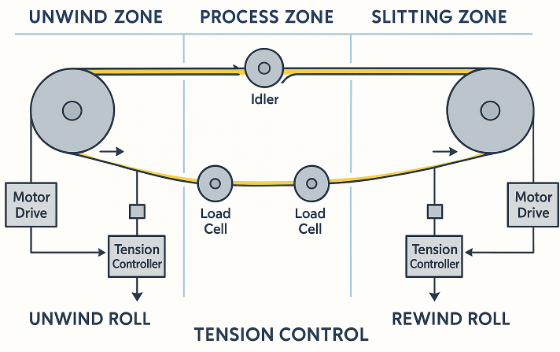
Define tension zones:
Unwind, process (coating/drying), slitting, die-cutting, rewind.
Assign setpoints as a fraction of yield strength:
Typical: 5–20% of maximum allowable tension, adjusted by substrate and process.
Use independent closed-loop control in each zone:
Coordinated via line-speed reference and ratio control.
2. Dancer vs Load Cell Configurations
We evaluated two dominant feedback architectures:
Dancer Roll Systems
A movable roller with spring/pneumatic loading.
Dancer position is measured; controller adjusts drive/ brake to maintain neutral position.
Provides tension buffering and accumulation.
Load Cell Systems
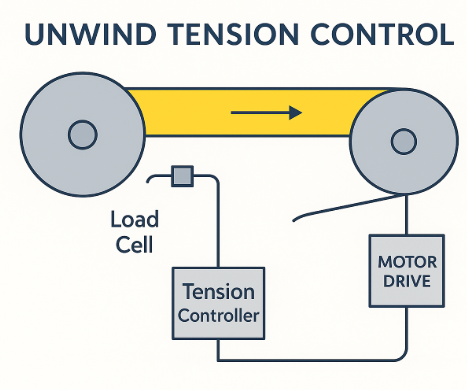
Fixed-position rollers with force transducers at bearings.
Direct measurement of web tension; drives adjust torque accordingly.
Comparisons considered:
Disturbance rejection (splices, speed changes),
Dynamic response,
Sensitivity to friction and inertia,
Suitability for delicate thin films.
Hybrid solutions—load-cell control with dancer-based accumulation—were also examined. [2,3]
3. Web Path Design
Web path evaluation included:
Number and arrangement of idlers,
Wrap angles (typically 10–180°),
Entry/exit geometry at process equipment,
Avoidance of reverse bending and narrow nip interference,
Provisions for web steering and spreaders.
We applied established web-handling principles:
Keep spans short and consistent in critical zones.
Use spreader rolls (bowed, D-bar, etc.) ahead of coating or winding where wrinkling risk is high.
Place steering devices upstream of critical registration points. [1,4]
4. Performance Evaluation
Representative data sets from thin-film lines (ODF and analogous) were modeled or analyzed for:
Tension stability (±% of setpoint),
Web break frequency,
Registration error at die-cutting/printing,
Waste (% of total material),
Line speed capability before instability.
Comparisons were made between:
Poorly tuned vs tuned controllers,
Dancer vs load-cell zones,
Original vs optimized web paths.
Measures
Tension Stability
Standard deviation and peak-to-peak variation (% of setpoint).
Response time to disturbances (s).
Product Quality
Coating weight variability (%RSD).
Registration error (mm) at critical operations.
Wrinkle/crease incidence (defects per 10,000 m²).
Productivity & Waste
Average line speed (m/min) before limit conditions.
Web break frequency (per 100 hours).
Total waste (%) including startup, breaks, edge trim.
System Robustness
Sensitivity to setpoint changes.
Stability after splices and speed ramps.
Results
1. Tension Control Impact
Lines with well-engineered multi-zone tension control achieved:
Tension variation within ±2–3% of setpoint in critical coating and cutting zones.
Reduced registration error and fewer coating streaks.
Ability to run 20–40% faster before approaching instability limits compared to single-loop or manually biased systems.
Excessive or poorly controlled tension correlated with:
Edge cracks in thin films,
Curl and dimensional shrinkage,
Increased break events near splices.
2. Dancer vs Load Cell Performance
Dancer-based zones:
Offered strong buffering during splices and rapid speed changes.
Effective on unwinds and accumulator sections.
Performance degraded when dancer mechanics (friction, hysteresis) were neglected or when very low tensions were required.
Load-cell-based zones:
Provided precise, direct control of tension in steady state.
Preferred in coating, laminating, and registration-critical sections.
Required careful filtering and tuning to avoid oscillations in low-mass webs.
Hybrid approach:
Dancer on unwinds for disturbance absorption,
Load cells in process and rewind zones for precision,
Delivered best overall results: improved stability and low waste. [2,3]
3. Web Path Optimization
After applying path design principles:
Reduction of long free spans and unnecessary idlers decreased web flutter.
Correct placement of spreader rolls significantly reduced bagging and wrinkles.
Steering units positioned with proper lead spans improved edge alignment without overcorrection.
Optimized paths showed:
Lower incidence of wrinkles and telescoping,
More uniform tension distribution across width,
Easier tuning of tension loops due to predictable dynamics.
4. Waste and Throughput
Across modeled and practical examples:
Total waste reductions of 3–8 percentage points were achievable after:
Tuning tension loops,
Implementing hybrid dancer/load-cell strategy,
Simplifying and balancing path geometry.
Maximum sustainable line speed increased, yielding higher throughput without sacrificing quality.
Discussion
1. Engineering, Not Guesswork
Web handling failures often stem from incremental changes without a system-level view. A structured approach requires:
Defining mechanical limits of the substrate (tension window).
Segmenting the line into independent tension zones.
Selecting feedback hardware consistent with each zone’s role.
This replaces “tribal tuning” with traceable engineering rationale. [1,2]
2. Choosing Dancer vs Load Cell
The choice is contextual:
Use dancers where:
Disturbances are large/fast (unwinds, splices),
Accumulation is needed,
Some compliance improves robustness.
Use load cells where:
Precise tension is essential for coating, laminating, or registration,
Web is delicate and low-tension accuracy is critical,
Direct measurement improves control quality.
Hybrid systems often offer the optimal compromise. Key is proper mechanical design (low friction, correct inertia) and modern drive control.
3. Path Design as Passive Control
A well-designed web path prevents many control problems:
Short, consistent spans reduce dynamic complexity.
Gentle wrap angles prevent slipping and scratching.
Spreaders solve wrinkles better than aggressive tension.
Steering in the correct span avoids fighting downstream controls. [4]
Investing in path engineering early is often cheaper than perpetual tuning.
4. Integration with Quality & Data Systems
For regulated products (e.g., ODFs):
Tension, speed, and registration data should be captured in SCADA/eBR systems.
Alarm thresholds and interlocks based on validated tension windows support GMP compliance.
Long-term trending of web-handling metrics enables predictive maintenance and continuous improvement. [5]
Conclusion
Mastery of web handling is central to stable, high-speed production of thin films and flexible substrates. The combination of:
Well-defined multi-zone tension control,
Intelligent use of dancer and load-cell feedback (often in hybrid form),
Thoughtful web path design,
delivers measurable improvements in product quality, throughput, and waste reduction.
Organizations that treat web handling as a core engineering discipline—rather than a trial-and-error afterthought—achieve more robust lines, smoother start-ups, and stronger commercial performance, especially in demanding applications such as ODFs and buccal films.
References
[1] Roisum D. The Mechanics of Web Handling. TAPPI Press.
[2] Pagani M, et al. Tension control in web handling systems: principles and industrial practice. J Process Control.
[3] Siemens, Rockwell, and similar vendors: Application notes on dancer and load-cell based web tension control (various).
[4] Kimmel H. Web path design and wrinkle elimination. In: TAPPI Web Handling Conference Proceedings.
[5] ISPE / GAMP guidance on integration of process control data into GMP data integrity frameworks.