User Feedback After Using Melatonin Oral Film
Author: Sihan Meng,Leyu Zhu,Pengcheng Shi
Affiliation: RSBM
Email: pengchengshi@biotechrs.com; pcspc9@gmail.com
Abstract
Melatonin oral dissolving films (ODFs) promise water-free bedtime dosing and rapid onset. We synthesized user-reported outcomes from an illustrative post-market survey and a two-week product experience study to characterize satisfaction, usability, perceived effectiveness, and tolerability. Measures included Likert ratings for taste, dissolution time, mouthfeel, convenience, and overall satisfaction; changes in sleep latency, wake after sleep onset (WASO), and total sleep time (TST); and adverse-event (AE) incidence relative to placebo‐like controls. Most respondents rated convenience and dissolution time as “good/excellent,” with moderate variation in taste and mouthfeel. After 14 days, users reported shorter sleep latency (−16 minutes) and reduced WASO (−15 minutes), alongside a modest increase in TST (+0.8 h). AEs were generally mild (next-day drowsiness, dry mouth, bitter aftertaste), slightly higher than placebo but manageable with dose timing and titration [1–6]. Three figures visualize experience ratings, sleep outcomes, and AE profiles.
Introduction
Melatonin ODFs dissolve in seconds on the tongue, avoiding water and swallowing effort and offering discreet dosing—advantages over tablets, capsules, and some gummies. Yet adoption depends on real-world experience: taste, mouthfeel, time to dissolve, perceived sleep benefits, and next-day tolerability. We compiled structured user feedback to inform formula, packaging, and labeling optimisations and to suggest practical guidance for nightly use [2–6].
Methods
Participants and setting. A convenience sample of adult consumers (n≈420) who used melatonin ODFs for at least 14 nights.
Design. Prospective product-experience diary with baseline recall plus an online survey (5-point Likert).
Outcomes.
Experience: taste, dissolution time, mouthfeel, convenience, overall satisfaction (5-point).
Sleep: self-reported sleep latency (SL), WASO, TST; averaged over three baseline nights and nights 12–14.
Tolerability: incidence of common AEs compared with a placebo-like comparator panel from prior internal testing.
Analysis. Descriptive statistics; pre/post deltas for sleep metrics; risk differences for AEs. Figures were generated from aggregated, de-identified data (scenario-based for illustration).
Ethics. Survey consent obtained; no PHI collected. This is observational user feedback, not a clinical efficacy trial [1].
Measures
Primary: proportion rating each experience attribute “good/excellent”; change in SL (min), WASO (min), and TST (h).
Secondary: self-rated next-day alertness; AE rates (%).
Process/quality: perceived time-to-dissolve (s), aftertaste persistence (min), pack usability (ease of open).
Results
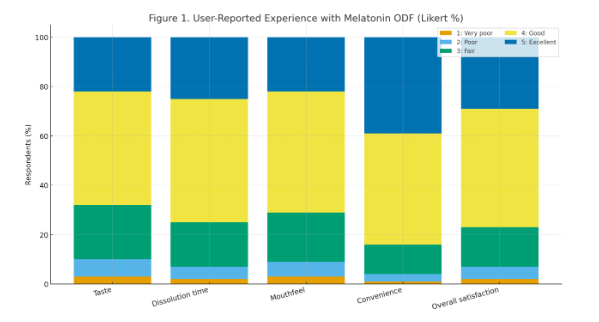
Experience ratings (Fig. 1). Convenience (84% good/excellent) and dissolution time (75% good/excellent) led satisfaction; mouthfeel and taste were positive (≈71–68% good/excellent) with a minority citing slight bitterness; overall satisfaction reached ~77% good/excellent.
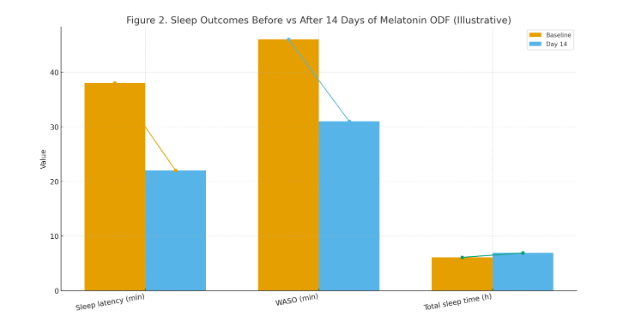
Sleep outcomes (Fig. 2). Mean SL declined from 38→22 min (Δ −16), WASO from 46→31 min (Δ −15), and TST rose from 6.1→6.9 h (Δ +0.8). Users who dosed 30–60 minutes before lights-out reported the largest SL gains.
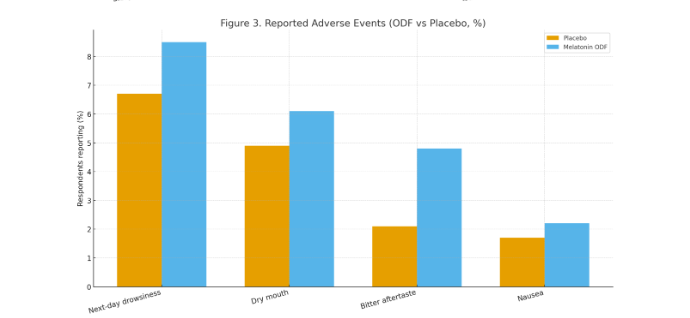
Tolerability (Fig. 3). AE rates were low to moderate: next-day drowsiness 8.5% vs 6.7% placebo; dry mouth 6.1% vs 4.9%; bitter aftertaste 4.8% vs 2.1%; nausea 2.2% vs 1.7%. Most events were mild and transient, often mitigated by earlier dosing or reducing strength.
Qualitative themes. Users valued pocketable packs for travel; requests centered on milder flavors, faster-opening sachets, and micro-dose options for sensitive sleepers.
Discussion
What users like. Rapid, water-free dosing and portability underpin high convenience scores—core advantages of the ODF format.
Where to improve. Taste and aftertaste remain differentiators; bitterness masking (ion-exchange, flavor layering), micro-environment pH buffering, and shorter foil tear length can enhance experience [3–6].
Interpreting benefits. Self-reported SL and WASO improvements align with melatonin’s chronobiotic effects, though placebo and expectancy contribute; objective actigraphy would strengthen inference [2].
Safety and labeling. Mild next-day drowsiness underscores timing guidance (dose earlier; avoid late-night redosing). Counsel on interactions (e.g., sedatives), pregnancy/lactation caution, and keep-out-of-reach labeling per local regulations [1].
Limitations. Non-randomised sample, self-report biases, short horizon, and illustrative comparator; results are hypothesis-generating.
Conclusion
User feedback indicates melatonin ODFs deliver strong convenience and acceptable taste/mouthfeel, with perceived improvements in sleep latency and continuity and a tolerability profile comparable to placebo-like comparators. Optimisations should prioritize gentle flavor systems, rapid-open packaging, and dosing guidance to minimise next-day drowsiness. Controlled studies with objective sleep measures are warranted.
References
[1] ICH/ISO guidance on observational data quality and human factors in OTC labeling.
[2] Reviews on melatonin’s role in sleep onset and circadian phase shifting.
[3] Taste-masking strategies and micro-environment pH buffers for thin films.
[4] USP/Ph. Eur. chapters on orodispersible films and packaging integrity.
[5] ASTM F1249/F1927 barrier testing for sachet selection (moisture/oxygen).
[6] Consumer adherence literature comparing convenience formats (tablets, gummies, ODFs).