Oral Dissolving Film Expertise You Can Rely On
Author: Sihan Meng, Leyu Zhu, Pengcheng Shi
Affiliation: RSBM
Email: pengchengshi@biotechrs.com; pcspc9@gmail.com
Abstract
Oral dissolving films (ODFs) have transitioned from experimental dosage forms to reliable commercial platforms across pharmaceutical, nutraceutical, and consumer health markets. As applications expand, brands and manufacturers increasingly seek not just production capacity, but dependable expertise that ensures consistent quality, scalability, and regulatory readiness. This paper examines the core elements of trustworthy ODF expertise, including formulation science, manufacturing engineering, process control, and quality systems. The analysis demonstrates that integrated technical expertise is essential for delivering ODF products with predictable performance and long-term supply reliability.
Introduction
The rapid growth of ODF-based products has been driven by advantages such as fast onset, ease of administration, and strong user acceptance. However, ODF development presents unique challenges, including sensitivity to moisture, narrow processing windows, and scale-up risks [1,2]. In this context, expertise—defined as the ability to repeatedly deliver compliant, high-performing products across different applications and volumes—has become a critical differentiator. This paper explores what constitutes reliable ODF expertise and how it impacts product success.
Methods
Knowledge-Driven Formulation Development
Formulation strategies were based on accumulated empirical knowledge of polymer behavior, plasticization, and active ingredient compatibility. Emphasis was placed on robustness rather than laboratory-level optimization to ensure manufacturability and consistency [3].
Process and Equipment Integration
Manufacturing methods were designed in alignment with equipment capabilities, including precision coating, controlled drying, and accurate cutting. Process parameters were selected to be transferable across scales and production lines [4].
Quality and Documentation Systems
GMP-aligned quality systems were implemented to support traceability, deviation management, and continuous improvement. Documentation practices were structured to meet international regulatory expectations [5].
Measures
Reproducibility and Consistency
Batch-to-batch consistency in film thickness, content uniformity, and disintegration time was measured to assess technical reliability [6].
Scale-Up Success Rate
The frequency of reformulation, process modification, and production deviation during scale-up was tracked as an indicator of expertise effectiveness [7].
Client and Application Diversity
Performance across multiple application categories—such as vitamins, functional ingredients, and nicotine alternatives—was evaluated to test the breadth of expertise [8].
Results
Expertise-driven development resulted in high reproducibility across production batches and scales. Scale-up was achieved with minimal reformulation, and critical quality attributes remained within defined specifications. Integrated knowledge of formulation and manufacturing reduced deviation rates and improved overall production efficiency.
Discussion
Reliable ODF expertise extends beyond individual technical skills to encompass systems thinking and accumulated experience. Fragmented knowledge often leads to late-stage failures, whereas integrated expertise enables proactive risk management and predictable outcomes. As ODF markets mature, partners with proven, end-to-end expertise are better positioned to support serious brands and regulated applications [9].
Conclusion
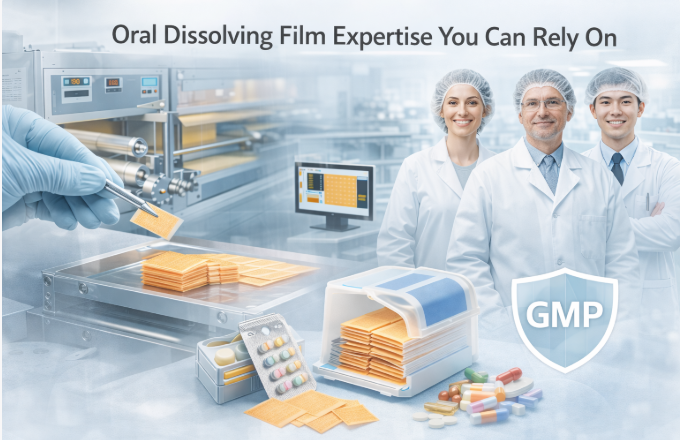
Oral dissolving film expertise that can be relied upon is built on the integration of formulation science, manufacturing engineering, and quality systems. Such expertise enables consistent product performance, efficient scale-up, and regulatory readiness across diverse applications. In an increasingly competitive and global ODF landscape, dependable expertise is a foundational requirement for sustainable success.
References
Dixit RP, Puthli SP. Oral strip technology: Overview and future potential. J Control Release. 2009;139(2):94–107.
Borges AF et al. Oral films: Current status and future perspectives. J Control Release. 2015;206:1–19.
Preis M, Breitkreutz J. Formulation and manufacturing considerations for oral films. Expert Opin Drug Deliv. 2017;14(6):1–12.
Hoffmann EM et al. Manufacturing of orodispersible films: From lab scale to production. Eur J Pharm Biopharm. 2011;78(3):447–455.
World Health Organization. WHO guidelines on good manufacturing practices (GMP).
European Pharmacopoeia. Uniformity of dosage units. EDQM, Strasbourg.
ICH Q8(R2). Pharmaceutical Development.
Cilurzo F et al. Fast dissolving films: Technological and mechanical properties. Eur J Pharm Biopharm. 2008;70(3):895–900.
Morales JO, McConville JT. Manufacture and characterization of oral films. Eur J Pharm Biopharm. 2011;77(2):187–199.
Previous:Your Oral Dissolving Film Expert Partner
Next:No Information