Essential Reading for Oral Film Newcomers: What Conditions Are Needed to Produce a “Mass-Producible Film”?
Essential Reading for Oral Film Newcomers: What Conditions Are Needed to Produce a “Mass-Producible Film”?
Author: Sihan Meng, Leyu Zhu, Pengcheng Shi
Affiliation: RSBM
Email: pengchengshi@biotechrs.com; pcspc9@gmail.com
Abstract
Oral Disintegrating Films (ODFs/OTFs) have attracted increasing attention as patient-friendly, fast-acting oral dosage forms. However, many early-stage projects fail when transitioning from laboratory prototypes to industrial production. A film that performs well at bench scale is not necessarily suitable for continuous, high-yield manufacturing. This paper provides an essential, practice-oriented guide for newcomers to the oral film field, defining the core conditions required to produce a truly “mass-producible film.” These conditions span formulation robustness, process stability, equipment compatibility, environmental control, and quality assurance. By clarifying common misconceptions and outlining measurable criteria for scalability, this paper aims to shorten the learning curve and reduce costly trial-and-error during commercialization.
Introduction
The appeal of oral films lies in their simplicity of use, rapid disintegration, and flexible dosing. In laboratory settings, it is often relatively easy to prepare thin films that dissolve quickly and carry an intended dose [1]. However, industrial production introduces constraints that fundamentally change what constitutes a “good” film.
For newcomers, the most frequent mistake is equating formulatable films with mass-producible films. Industrial production requires continuous coating, drying, cutting, and packaging under narrow process windows [2]. This paper addresses a foundational question: what conditions must be satisfied for an oral film to be manufacturable at scale, rather than merely functional in the lab?
Methods
This work synthesizes peer-reviewed literature, pharmacopeial guidance, and accumulated industrial manufacturing experience in oral film production. Key failure modes observed during scale-up were analyzed and grouped into critical condition categories. These categories were then translated into practical, measurable requirements that define mass-producibility [3].
Defining a “Mass-Producible Film”
A mass-producible oral film is defined as a formulation and process combination that can be:
Manufactured continuously or semi-continuously
Reproduced with consistent quality across batches
Converted into unit doses with high yield and low waste
Packaged and stored with acceptable stability
This definition emphasizes process compatibility rather than laboratory performance alone [4].
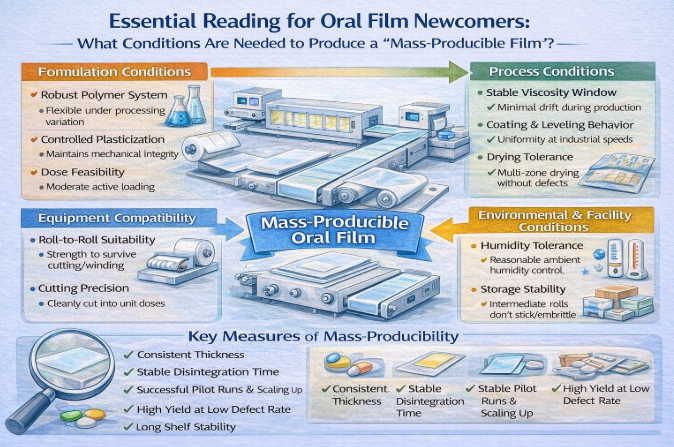
Formulation Conditions
Robust Polymer System
The polymer matrix must tolerate minor variations in solid content, temperature, and shear without phase separation or viscosity collapse. Films that rely on extremely narrow formulation windows are unsuitable for scale-up [5].
Controlled Plasticization
Plasticizer levels must provide flexibility without causing tackiness, blocking, or migration during drying and storage. Over-plasticized films often appear acceptable at small scale but fail during roll handling.
Dose Feasibility
The active ingredient load must be compatible with film thickness and mechanical strength. Mass-producible films typically avoid operating at the maximum theoretical loading capacity [6].
Process Conditions
Stable Viscosity Window
Coating solutions must maintain stable viscosity over production time, resisting polymer hydration drift and temperature-induced changes. Viscosity instability leads to thickness variation and coating defects [7].
Coating and Leveling Behavior
A mass-producible film must level uniformly at industrial coating speeds. Formulations that rely on very slow coating or extended resting times are not scalable.
Drying Tolerance
The film must withstand multi-zone drying without cracking, curling, or active migration. Sensitivity to minor drying fluctuations is a strong indicator of poor scalability [8].
Equipment Compatibility
Roll-to-Roll Suitability
Films must be strong enough to survive unwinding, rewinding, slitting, and die-cutting without tearing or excessive dusting.
Cutting Precision
Dose accuracy in oral films is area-based. A mass-producible film must cut cleanly and consistently, without edge deformation that compromises unit dose [9].
Environmental and Facility Conditions
Humidity Tolerance
Films that only remain stable at extremely low humidity are impractical for most production environments. Reasonable tolerance to ambient fluctuations is essential [10].
Storage and Handling Stability
Intermediate rolls must remain stable during short-term storage and transport within the facility, without sticking or embrittlement.
Measures
The following metrics are commonly used to assess mass-producibility [11,12]:
Thickness and weight uniformity across long runs
Tensile strength and elongation under process tension
Disintegration time consistency
Yield after slitting and die-cutting
Defect rate per unit length or batch
These measures focus on process outcomes, not just final product attributes.
Results
Experience from pilot and commercial production shows that films meeting the above conditions demonstrate:
Significantly higher production yields
Reduced downtime and adjustment frequency
Improved batch-to-batch consistency
Faster regulatory and market readiness
Conversely, films optimized only for laboratory performance frequently fail during extended production runs [13].
Discussion
For newcomers, the most important mindset shift is recognizing that oral film development is a manufacturing-driven discipline. Unlike tablets, where compression can mask certain formulation weaknesses, oral films expose every instability during continuous processing [14].
Mass-producibility is therefore less about achieving extreme performance metrics (e.g., fastest possible disintegration) and more about achieving balanced robustness. Early incorporation of manufacturing thinking into formulation design is the single most effective way to reduce development risk.
Conclusion
A “mass-producible film” is defined not by how well it performs in a beaker or petri dish, but by how reliably it can be produced, converted, and packaged at scale. Essential conditions include formulation robustness, process tolerance, equipment compatibility, and environmental stability. For oral film newcomers, understanding and applying these principles early is critical to transforming promising concepts into commercially viable products.
References
Fu Y et al. Expert Opin Drug Deliv. 2004;1(4):673–690.
Preis M. J Pharm Pharmacol. 2013;65(2):157–170.
Cilurzo F et al. Eur J Pharm Biopharm. 2008;70(3):895–900.
Dixit RP, Puthli SP. J Control Release. 2009;139(2):94–107.
Bala R et al. Int J Pharm Investig. 2013;3(2):67–76.
Morales JO, McConville JT. Ther Deliv. 2011;2(5):637–646.
Hoffmann EM et al. Pharm Res. 2011;28(8):1914–1922.
Borges AF et al. Int J Pharm. 2015;494(1):332–339.
Arya A et al. Int J PharmTech Res. 2010;2(1):576–583.
Shojaei AH. J Pharm Pharm Sci. 1998;1(1):15–30.
USP <701> Disintegration Test.
USP <905> Uniformity of Dosage Units.
Keshari R, Keshari S. J Drug Deliv Ther. 2014;4(4):1–7.
Preis M et al. Drug Dev Ind Pharm. 2014;40(2):152–160.