Where Do Hit Products Come From?
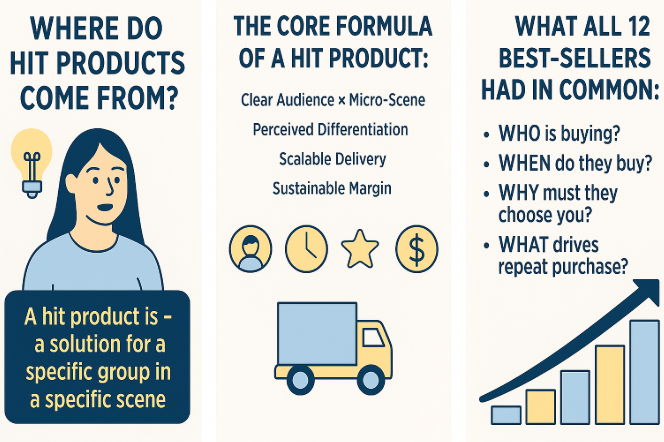
The Fundamental Answer After Creating 12 Best-Sellers Myself**
Anyone who has been in business long enough knows a brutal truth:
You can launch dozens of products, but the ones that truly keep the team alive—the ones that generate sustained cash flow—are usually just one or two true hits.
Many people assume hit products come from:
Lucky timing
Large ad budgets
Platform traffic support
But after creating 12 real best-selling products, my conclusion is brutally simple:
A hit product is not “something that sells well.”
It is a solution that a specific group of people repeatedly chooses in a specific scene.
Below is the distilled, bottom-level framework that appeared again and again in all 12 projects—and the exact steps you can directly copy.
**1. The Core Formula of a Hit Product:
5 Elements, All Mandatory**
Whenever I evaluate a potential hit, this formula automatically appears in my mind:
Hit Product = Clear Audience × Micro-Scene × Perceived Differentiation × Scalable Delivery × Sustainable Margin
Let’s unpack it:
1. Clear Audience
Not “women aged 18–45.”
But:
“Female office workers who commute daily and stay up late”
“Pet owners with anxious pets who hate injections”
If you can picture the user clearly, your product is far more likely to explode.
2. Micro-Scene
Not “health is important,” but:
“Rushing to the subway with no time to swallow a vitamin tablet”
“Every vet visit turns into a wrestling match with the pet”
3. Perceived Differentiation
Something the user can identify instantly:
“This dissolves faster”
“This is easier to carry”
“This avoids injections”
4. Scalable Delivery
Not handmade masterpieces—
but a product that supply chain can deliver consistently, repeatedly, and at scale.
5. Sustainable Margin
A product that sells well but loses money is not a hit—it’s a liability.
Real hits must:
Delight users
Support advertising
Fund customer service
Sustain ongoing operations
Most “fake hits” die because:
either the experience is unstable, or the margin cannot sustain growth.
**2. What All 12 Best-Sellers Had in Common:
Always Start With “Who, When, Why You”**
Whether it’s vitamin ODFs, calming pet films, education consumables, or e-commerce goods, all real hits shared the same structural logic.
1. WHO Is Buying? (The user’s picture must be vivid)
Demographics are superficial.
You need to understand:
Daily rhythm
Purchasing triggers
Emotional pressure points
What they avoid or fear
What they feel guilty about
What they repeatedly complain about
A hit always begins with one core user group, not everyone.
2. WHEN Do They Buy? (Scene must be small, sharp, specific)
“Taking vitamins” is too broad.
But:
“Running late in the morning yet wanting a quick vitamin B/C boost”
“Pet shaking in fear before every vet visit”
are concrete and powerful.
3. WHY Must They Choose You? (3-second perceived difference)
If your differentiation cannot be understood in 3 seconds, it's not strong enough.
Examples:
“Vitamins you don’t need to swallow”
“A needle-free calming option for nervous pets”
“Pocket-sized and dissolves instantly”
4. What Drives Repeat Purchase? (A natural loop)
Hit products have built-in reasons to repurchase:
Daily routines
Repeated scenes
Habit cycles
The usage chain must have zero friction points.
5. Does Each Sale Make the Next One Easier? (The mini flywheel)
True hits generate:
Positive reviews
Real user content
Natural word-of-mouth
Each sale should help you sell the next one.
3. A Directly Copyable 5-Step Method to Build a Hit Product
Step 1: Define Your Audience by Asking: “Who Is Not My User?”
Start by excluding:
People outside your price band
People who will never use this format
People whose scenarios don’t match
When you can confidently say:
“This product is NOT for everyone,”
you’re moving toward a real hit.
Step 2: Write One Sentence That Describes the Pain of Not Buying Today
Powerful hits always provoke instant emotional recognition:
“Gagging every time you swallow a large tablet”
“Every vet visit turns into a battle”
“Always too tired to take your vitamins at night”
Your product’s value then becomes one crisp answer:
“Vitamins without swallowing”
“A needle-free calming option”
“A B-complex boost while walking to work”
Step 3: Build a 3-Second Differentiation Moment
User picks up the product → immediately feels:
Thinner
Faster dissolving
Easier tear-open
Less smell
Comfortingly simple
For pet products:
No needles
No force-feeding
Owner can administer calmly at home
Step 4: Break the Experience Into 5 Micro-Interactions and Polish Each One
First visual impression
Unboxing (easy or frustrating)
Action required to use
Taste / feel / comfort / effect
Whether they naturally think “Next time I’ll use this again”
Hits don’t rely on one highlight moment—
they avoid all “drop-off moments.”
Step 5: Build a Mini “Awareness → Purchase → Review → Repurchase” Flywheel
Awareness: short content, demos, scenario-based hooks
Purchase: one sharp benefit dominates your sales page
Review: incentivize photo or scenario posts
Repurchase: simple reminders + habit cycles
If every new buyer helps you attract the next one →
that is a true hit.
4. The 3 Biggest Lessons From My 12 Best-Sellers
1. Real hits come from “small needs in high-frequency scenes.”
Not grand missions.
Not big universal pain points.
But tiny daily frustrations:
Can’t swallow tablets
Pet terrified of injections
Don’t want others seeing you take pills
**2. Great product ≠ Hit product
Your message must be stupidly simple.**
Inside the company, you can talk about:
formulation
coating technology
dissolution curves
But for users, the message must be:
“One strip solves this specific issue.”
3. Hits are not one-time fireworks—they are cash-flow engines
A product that sells but loses money is not a hit.
A true hit must sustain:
margins
ads
innovation
team growth
**5. Want to Build a Hit Now?
Start by Answering These 10 Questions**
Pick your most promising idea and answer:
Who is the core user?
What exact moment triggers the need?
If you didn’t exist, how would they cope?
Can your differentiation fit into one sentence?
Will users feel “This is different” in 3 seconds?
Any friction point that can instantly kill the experience?
What makes them want to use it again naturally?
Does your margin support ads + ops + service?
Can your supply chain scale if demand 5×?
Does each customer help you gain another?
If more than 3 answers make you uncomfortable,
it’s not ready to be a hit.
FAQ
Q1: Can small brands create hit products without big budgets?
Yes.
Budget affects “how fast” you grow, but fit between user × scene × differentiation is what determines whether a product can become a hit.
Many small teams built hits by focusing on one micro-scene first.
Q2: Do hit products always mean low price?
No.
Hit products deliver high perceived value, not necessarily low absolute cost.
Saving time, reducing embarrassment, lowering effort—these are all “value.”
Q3: What’s the difference between a hit product and a long-term seller?
Hit product = rapid, intense growth; brand amplifier
Long-term seller = stable, reliable, recurring revenue
The ideal strategy:
Use hits to break the market → use long-sellers to stabilize cash flow.
Q4: Can a brand build multiple hit products at once?
Not early on.
When resources are limited, focus is everything.
Dominate one scene first—then replicate the methodology.