Systematic Formulation–Process–Evaluation Approach and QbD Practice for Oral Dissolving Films (ODFs)
Systematic Formulation–Process–Evaluation Approach and QbD Practice for Oral Dissolving Films (ODFs)
Author: Leyu Zhu,Sihan Meng
Affiliation: RSBM
Abstract
English: (ODFs) provide swallow-free administration, pleasant mouthfeel, and fine-tunable dosing, accelerating their adoption across pharmaceuticals, nutrition, and oral-care markets. This paper presents a reusable Quality-by-Design (QbD) pathway for ODF development—TPP/TPQA → CQA → CMA/CPP → Design Space → Control Strategy—that systematizes material selection windows for film formers, plasticizers, solubilization and taste-masking systems, mucoadhesive/controlled-release polymers, and flavors/sweeteners; proposes three representative starter formulas; and links them to critical coating/drying/conditioning/packaging steps. Practical quality metrics are summarized for disintegration/dissolution, assay & content uniformity, mechanical properties, water activity, microbiology, seal integrity, and sensory, together with stability/packaging tactics to improve first-pass success and scalable tech transfer across diverse actives and use cases. ¹²
Keywords: oral dissolving films; film-forming polymers; taste masking; mucoadhesive controlled release; QbD; CQA; CPP; stability; unit-dose packaging
1. Introduction
ODFs deliver rapid onset, strong adherence, and portability through a “thin film → fast hydration → disintegration/adhesion” pathway. A QbD approach—combining risk assessment, statistical design, and in-line monitoring—creates a transferable development flow in which materials–process–packaging–stability co-optimize within a defined design space, outperforming empirical trial-and-error.¹³ The goal here is to provide materials-selection logic, process windows, critical quality attributes (CQAs), and verification methods as an actionable toolkit for project initiation and scale-up.²
2. Methods
This is a methods/practice-oriented narrative review that: (i) maps ODF formulation/process factors in QbD terms; (ii) distills implementable parameter ranges and QC checkpoints; (iii) offers three starter formulations plus DoE suggestions; and (iv) summarizes stability/packaging strategies and regulatory notes. No patient-level data or quantitative meta-analysis are included.¹²
3. Findings
3.1 Target Product Profile/Attributes (TPP/TPQA)
Administration path: immediate sublingual/buccal, mucoadhesive local therapy, or GI absorption.¹
Disintegration window: 10–30 s for immediate release; >3–20 min for mucoadhesive/extended release (use-case dependent).¹⁴
Unit mass/thickness: 20–1000 mg; typical dry thickness 60–150 μm.¹
Palatability: ≤slight bitterness, smooth mouthfeel; optional cooling and aroma.⁵⁶
Mechanical properties: tensile strength with adequate elongation; no edge cracking on peel.⁷
Stability: acceptable appearance/assay/dissolution from ambient up to 40 °C/75 %RH.⁸
Packaging: high-barrier unit pouches (e.g., PET/AL/PE) with easy-tear/easy-peel.⁹
Regulatory: compliant excipient lists, labeling/claims, GMP, and microbial limits for the target market.¹⁰
3.2 Materials System
3.2.1 Film-forming polymers (matrix)
Immediate-release: HPMC (E3–E6), PVA, pullulan, PVP, hydroxypropyl starch—chosen for fast swell-to-network breakup, smooth mouthfeel, and plasticizer compatibility.¹⁴
Mucoadhesive/extended: carbomer, cross-linked PVP, CMC-Na, chitosan, and poly(acrylic-acid) blends—to increase residence time and form gel layers with salivary electrolytes.¹¹
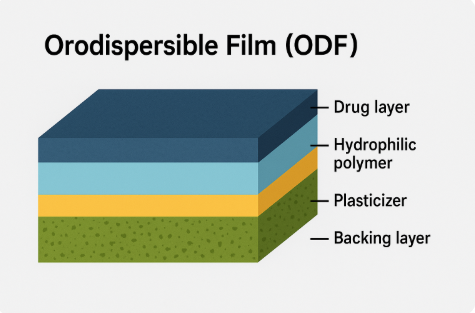
Layering/backing: IR layer + mucoadhesive layer; or drug layer + taste/mouthfeel layer; add an occlusive backing for unidirectional release when needed.¹¹¹²
3.2.2 Plasticizers & wetting aids
Plasticizers: glycerol, propylene glycol, sorbitol, PEG-400/600—lower Tg, improve flexibility/anticrack; excessive levels risk tackiness and delayed disintegration; typical optimization 15–30 % (w/w solids).¹⁴
Wetting/solubilizing aids: polysorbates/low-level surfactants and propylene glycol to accelerate hydration and early release.¹
3.2.3 Solubilization & solid dispersion
Approaches: amorphous solid dispersions, cyclodextrin inclusion, salt/ionization strategies, and micro-pH control. Objectives: increase instantaneous salivary availability, reduce bitter exposure, and prevent recrystallization.⁵⁶
3.2.4 Taste masking & mouthfeel engineering
Techniques: core–shell/multilayer structures, ion-exchange resins, microencapsulation, cyclodextrins, and flavor-sweetener-cooling synergies. User-experience cadence: pleasant perception at 3–5 s, full disintegration by 10–30 s.⁵⁶
3.2.5 Mucoadhesion & controlled release
Polymers: carbomer/chitosan/cross-linked PVP. Unidirectional release: single-side coat + EVA/PET backing to bias diffusion toward mucosa. Metrics: residence time, interfacial adhesion, mucosal flux.¹¹¹²
3.2.6 Other functional excipients
Sweetness/flavor/cooling: sucralose, acesulfame-K, aspartame, menthol, cooling esters.
Stabilization: antioxidant/antimoisture systems (e.g., citrate buffers, desiccants) and anti-recrystallization agents.
Preservation: sodium benzoate/potassium sorbate where permitted and sensory-acceptable.¹⁰
3.3 Process & Critical Process Parameters (CPPs)
Solution make-up: aqueous or aq-alcohol; allow full polymer swelling before adding plasticizers and actives/flavors; viscosity 1000–5000 mPa·s is coatable.¹³
Deaeration/filtration: vacuum or ultrasonic to avoid bubbles/pinholes.¹³
Coating: comma-bar/slot-die/doctor-blade; compute wet thickness from target dry thickness and solids (with shrinkage).¹³
Drying curve: staged temperatures (e.g., 40→60→75 °C) to avoid case-hardening/inner collapse; control residuals and internal stress.¹³
Conditioning: 25–35 °C, 40–60 %RH for plasticizer/water redistribution and mechanical stabilization.¹³
Slitting/die-cutting: minimize burrs and hold tight dimensional tolerances; in-line weight checks.¹³
Unit packaging: heat-seal high-barrier laminate; verify seal strength and leak integrity; ensure easy-tear/easy-peel design.⁹
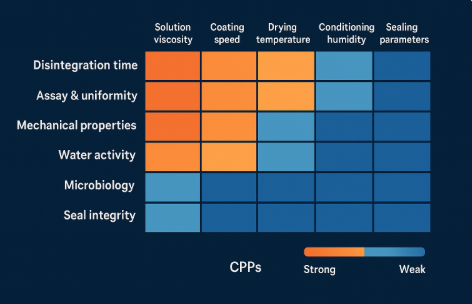
Typical CPPs: solution viscosity; coating speed/gap; drying temperature/airflow/residence; conditioning time/RH; seal temperature/pressure.¹³
3.4 CQAs & Methods
Appearance/dimensions: visual + machine vision.
Thickness & mass variation: micrometer/β-gauge; engineering target RSD ≤ 5 %.⁷
Assay & content uniformity (AV): HPLC/UPLC per pharmacopoeia.¹⁰
Disintegration/dissolution: simulated saliva (pH 6.8, low/no surfactant); flow-through cell if needed; target 10–30 s or product-specific profiles.¹⁴
Mechanical properties: tensile and bend tests.⁷
Moisture & water activity (a_w): Karl Fischer and water-activity meter.⁸
Microbiology & preservative efficacy: per target-market standards.¹⁰
Package integrity: dye ingress, vacuum-decay, or helium leak; evaluate WVTR/OTR for barrier performance.⁹
Sensory & acceptability: sweetness, cooling, aftertaste, irritation, and overall liking—panel/consumer tests.⁶
3.5 Stability & Packaging Strategy
Chemical stability: pH buffering, antioxidant pairing, light protection.⁸
Physical stability: anti-recrystallization, plasticizer-migration control, and Tg–humidity balance.⁸
Moisture management: low-a_w formulation + high-barrier unit pack + desiccant secondary.⁹
Stability plans: 40 °C/75 %RH, 30 °C/65 %RH, 25 °C/60 %RH with trending of assay, dissolution, palatability, and appearance.⁸
3.6 Representative “Starter” Formulas (dry-basis ranges; to be optimized)
Starting windows; refine with the active’s physicochemistry and regulatory constraints.
A. Immediate-release functional (stimulation/sleep aid/vitamins)
Film former HPMC/Pullulan 60–75 %; plasticizer (glycerol/PG) 15–25 %; sweetness+cooling 3–6 %; buffer/solubilization 2–5 %; active to target dose (fast-dissolving actives typically ≤ 20–50 mg per film). Target: 10–20 s disintegration; smooth mouthfeel; moderate strength.¹⁴
B. Mucoadhesive local-therapy (ulcer/desensitizing/antimicrobial)
Mucoadhesive base Carbomer/XL-PVP/Chitosan 40–60 %; plasticizer 10–20 %; buffer & mucosal protectants 5–10 %; add backing if required. Target: 5–20 min residence; mucosa-directed release.¹¹¹²
C. “Fast + Sustained” bilayer
Top IR layer (HPMC/PVA) + bottom mucoadhesive (carbomer) with a middle isolation layer to prevent migration. Target: early peak within ≤ 5 min plus 30–60 min maintenance (active-dependent).¹¹¹²
3.7 DoE & Control Strategy
QRM identification: fishbone/FTA to identify CMAs/CPPs impacting CQAs.²
DoE: Box–Behnken/central-composite/mixture designs; factors (polymer ratio, plasticizer level, drying temperature, etc.); responses (disintegration time, tensile strength, AV).¹³
Multi-objective optimization: desirability to meet ≤ 30 s disintegration + ≥ X MPa strength + AV compliance concurrently.¹³
Control strategy: establish PAT (in-line thickness/weight), batch-release criteria, and auditable design-space documentation.²
4. Discussion
Key ODF challenges arise from cross-disciplinary coupling—polymer glass transition and plasticization, saliva hydrodynamics and pH, backing-driven interfacial adhesion, and drying stress/residuals—all shaping the balance of palatability–disintegration–strength–stability. Layered structures and unidirectional release reduce swallowed loss and improve mucosal flux; high-barrier unit packs plus in-line QC minimize scrap and variability. Future work should build IVIVC/IVRT models, quantify real-world adherence/outcomes, explore biodegradable backings, and digitize mass-customization for small-batch multi-strength production.¹¹¹²¹³
5. Conclusion
QbD-guided ODF development starts from TPP/TPQA to back-cast CQAs, then constructs an integrated design space across materials–process–packaging–stability. With taste/mouthfeel engineering, layering/backed unidirectional release, DoE-based optimization, and high-barrier unit packaging, teams can markedly improve first-pass success and reproducible scale-up, enabling high-quality, scalable ODF solutions for drug, nutrition, and oral-care applications.¹²¹³
Resources / References (superscripts map 1–14)
Jacob S, Nair AB. Orodispersible films: current innovations and emerging trends in oral drug delivery. Pharmaceutics (review).
ICH Q8(R2) Pharmaceutical Development; ICH Q9(R1) Quality Risk Management; ICH Q10 Pharmaceutical Quality System.
Yu LX, Kopcha M. The future of pharmaceutical quality and the path to QbD. Int J Pharm (commentary).
Ferlak J, Hlawacz I, Kucharska M, et al. Orodispersible films—state of the art, limitations and future perspectives. Pharmaceutics (review).
Adamkiewicz L, Szymaszkiewicz A, Kozłowska J. Cyclodextrins as taste-masking agents in oral dosage forms. Pharmaceutics (review).
Thakker P, et al. Taste masking of pharmaceutical formulations: technologies and trends. J Control Release (review).
Centkowska K, et al. Homogeneity and mechanical properties of ODFs—impact of composition/processing. Pharmaceutics / Eur J Pharm Sci.
General guidance on water activity (a_w) and stability for solid orodispersible systems (USP/Ph. Eur. texts and thin-film stability reviews).
ASTM standards: F88 (seal strength), F1249 (WVTR), D3985/F1927 (OTR), F2338 (vacuum-decay leak).
USP/Ph. Eur. chapters on microbial limits (e.g., USP <61>/<62>), preservative efficacy (USP <51>), and content uniformity (USP <905>).
Madhav NVS, Shakya AK, et al. Mucoadhesive drug delivery systems: formulation and evaluation (review).
Grilc B, Šturm L, Planinšek O, et al. Backing layers and unidirectional release from buccal films. Pharmaceutics (study/review).
QbD/DoE toolkits for film casting and scale-up (Box–Behnken, central composite, mixture designs)—textbooks and pharmaceutics reviews.
Practical ODF targets for <30–60 s disintegration and IR polymer systems—ODF formulation reviews in Pharmaceutics / Eur J Pharm Biopharm.