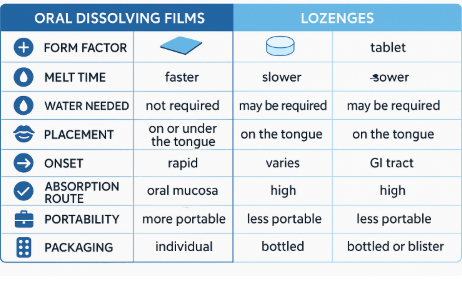
What are the differences between oral dissolving films (ODFs) and lozenges/orally disintegrating tablets (ODTs)?
Form & dose
ODF: ultra-thin polymer film; ideal for low–moderate doses (typ. 1–30 mg; up to ~50–100 mg with lamination/ASD).
ODT/lozenge: compressed/formed solid; can carry higher doses (tens–hundreds of mg).
Patient experience
ODF: water-free, very fast mouthfeel; adheres to the tongue/cheek, minimal grit.
ODT/lozenge: disintegrates or dissolves as a tablet/candy; mouthfeel may be chalky or bulky.
Taste-masking
ODF relies on inclusion/resinate/micro-coating + sweet–acid/flavor; thinness means careful balance.
ODT/lozenge can bury taste in bulk matrix and sweeteners.
Manufacturing & packaging
ODF: roll-to-roll coating → drying → slitting/die-cut → unit pouches/blisters.
ODT/lozenge: granulation/compression or cooking/molding → standard blisters/bottles.
Previous:No Information
Next:How can we control disintegration time to 10–30 seconds?