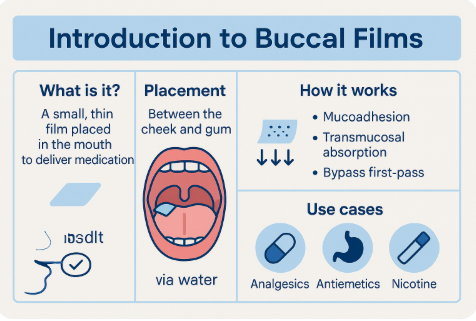
What Is a Buccal Film
A buccal film is an ultra-thin strip applied to the inner cheek. It requires no water, softens or dissolves with saliva, and can be engineered for instant melt or mucoadhesive residence. As a unit dose (one strip = one dose), it improves accuracy and adherence.
How It Works (Brief)
After placement, saliva wets the film; the matrix (e.g., HPMC/pullulan/PVA with mucoadhesive polymers such as carbomers/alginate) swells and releases the active. A fraction permeates the buccal mucosa, partly bypassing first-pass metabolism for faster perceived onset, while the remainder is swallowed and absorbed via the GI tract.
Benefits & Use Cases
Compared with tablets/capsules, buccal films are water-free, discreet, and faster-feel; versus lozenges/sprays, they offer precise unit dosing and controlled residence. Typical uses include commuting/meetings/flights, dysphagia-friendly dosing (children, seniors, post-op/orthodontic), oral-care/local actions, and on-demand nutrition/OTC (therapeutics per medical advice and local regulations).
Formulation & Quality Essentials
Typical thickness 50–120 μm. Balance mucoadhesion–comfort–release via plasticizers (glycerin/sorbitol/PEG 400), micro-pH control, compliant solubilizers/permeation aids, and taste masking. Key specs: dose uniformity (CV ≤ ±2–3%), dissolution/release and adhesion strength, residual moisture/water activity, and consistent sensory profile.
Packaging & Storage (Key Points)
Use high-barrier 4-side seals or blisters to prevent deliquescence and curl; add desiccants/nitrogen as needed and validate WVTR/OTR and shipping humidity. Follow labeling/medical advice; minors, pregnancy/lactation, and chronic conditions should seek professional guidance before use.